
The company that I work for is a relatively small company with about sixty five employees. However, almost all of the companies with whom we do business are very large U.S. corporations and since we are a service business operating hundreds and even thousands of miles from their corporate headquarters we have only a limited knowledge of their inner workings. Nevertheless, every now and then a tiny window opens and gives us a fleeting glimpse into their day to day operations and decision making and we are amazed at the internal struggles for power within their organizations. This generally sets off a discussion among us as to who really has the power in their corporate system. It seems as though these large organizations are giant crucibles who take people in and grind them up and spit out all except those who know the secret of power. I have sometimes wondered about power and if it comes mainly from money, or good looks, or influence, or family ties, or intelligence, or wisdom, or knowledge, or altruism, or greed, or divine appointment, or ruthlessness, or just plain luck. Perhaps it is a combination of all of these. I like to imagine that if one could get a handle on the formula for power one might be able solve some of mankind's most pressing problems.
The biggest question about power is how to regulate it. It seems to be a tenet of human nature that unregulated power leads to corruption and that is why we are now collectively questioning the wisdom of an unregulated free market. In our current democratic situation the strong seem do what they can get away with and the weak suffer what they must in order to get by. In our electoral process the average citizens or "little people" tend favor the charismatic contender whether or not he or she is the best candidate for the job. Is this how a country should be governed? If we allow the public to vote for those "in power" based on their emotions rather than on a well informed and carefully thought out decision making process it may only further the pickle that we seem to be in.
This morning I was listening Fareed Zakaria, the editor-at-large for Time Magazine and the host of CNN's "Fareed Zakaria GPS". He gave a simple definition of power that stuck with me all day. He said "Power is the ability to obtain the outcome that you want". That is simple but it is also genius in my opinion. Instead of asking "Who has the power?", we need to ask instead, "Who has the ability?". This Tuesday, January 25th, Barack Obama will give his second State of the Union address to Congress. We are at a critical point in time. Polls show that impatience, frustration and anxiety are at an all tine high. I think that I can safely say that not only American citizens but people the world over want the United States of America to return to a path of steady growth and prosperity because the American model is still the desired hope and dream for billions of people.
Does Barack Obama have the ability to obtain the outcome that we want? I think that he does. I will be glued to the T.V. set to hear what he has to say. Does the U.S. Congress have the ability (and the guts) to obtain the outcome that we want? I think that they do if they sincerely believe that the trust their constituents have placed in them to do the right thing is sacred. If that is the case...if both the President and the Congress have the ability ( i.e., the power) to obtain the outcome that we want then what are we waiting for? Let's get this show on the road!
23 January 2011

16 January 2011
From Linear to Exponential
Back in 1973 a fellow named Merle Haggard wrote a song about the tender optimism of a working man dealing with economic hardship. I relate to this particular song because at the time it was written I was dealing with economic hardship myself. In October of 1973 we were hit with the Arab Oil Embargo crisis and by Christmas that year and it seemed as though the lights were going out all over North America. There were gas lines everywhere and there was a line from that song that was on every one's mind at the time and it went:
If we make it through December
Every thing's gonna be all right I know...
Here in Mexico there is a similar sentiment but it differs in that the month that is the hardest to get through is not December but January. By the end of the year the Christmas holidays have taken their toll on the pocketbook and there is still "El Día de Los Reyes Magos" (The Feast of the Three Kings) on the Epiphany, January 6th to deal with. Many Moms and Dads literally go into hock at a pawn shop (casa de empeños) to get enough money to buy clothing and toys for their children who are expecting Melchor, Gaspar and Baltasar, the three wise men, to bring them gifts. The prudent parents buy the gifts (regalos) on "el plan de apartado" or "layaway plan" to be redeemed on the night of January 5th, the eve of the Epiphany, after the kids have been put to bed. To be sure, the Day of the Three Kings is a great day but after that there is a long hard climb out of debt. Many people who are caught off guard by emergencies during the holidays have had to borrow money from their employer or put off paying the rent or utilities and it is also a time when property taxes become due. That is why people often refer to January as "la cuesta de enero" or "the hill of January". A friend of mine noted recently that this year we will not only have "la cuesta de enero" to deal with but also "la cuesta de dos mil once" or "the hill of two thousand eleven".
This brings me to the title of this blog post, "From Linear to Exponential". I first encountered this phrase in the late 1980's while investigating the maintenance cost cycle of railroad equipment. The monthly maintenance cost would start out at next to nothing and rise very, very slowly over the years in a gradually rising straight line or in a "linear fashion". This would go on for many years until at some point, usually predictable, the various components would begin to wear out more or less simultaneously and the the maintenance cost would take an abrupt upward turn in an alarmingly steep manner or "exponential fashion" and this would indicate the end of a useful life cycle. The owner of the equipment would then need to decide to either completely refurbish the equipment or replace it. We now seem to be at that point with the debts of many nations and the availability of resources. The cause of this linear to exponential change in direction was also generally predictable and we were first warned about it by a man named Thomas Malthus. In 1798 he published An Essay on the Principle of Population which said that the growth of population will eventually reach the limit of the resource base, this resource base, of course, being the planet Earth.
It is hard to get one's head around the math behind exponential growth because our lives are linear and our activities generally don't involve the powers of ten. My father used to explain it by using the story of the chess board with 64 squares. One day a man brought a new game called "chess" to the king and the king enjoyed the game so much that he told the man that he could have anything that he wanted as a reward. The king asked what he would like and the man surprised the king by asking for one grain of rice on the first square, two grains on the second square, four grains on the third square etc. The king readily agreed and called for the rice to be brought in. All went well at first but by the time they got to the thirty-second square they needed 4,294,967,295 grains of rice or in other words about 118 tons. This is enough rice to fill a modern jumbo railroad covered hopper car full to overflowing. Then, on the very next square the amount doubled and they came to the point that some people refer to as, "the second half of the chess board" where the increase becomes so steep that it is almost impossible to deal with. In fact, if the king had kept on rewarding the man with rice according to the agreed upon plan, by the time they reached the sixty-fourth square there would be 18,446,744,073,709,551,615 grains of rice, weighing 501,270, 219, 565 tons, which would be a mountain of rice larger than Mount Everest.
The national debt of the United States is getting uncomfortably close to that "second half of the chess board". Not only that but scientists are telling us that the growing world population, falling energy sources and food shortages will create some almost insurmountable difficulties by the year 2030 if some drastic measures aren't taken immediately. Food reserves are already at a fifty-year low but by 2030 the world will require 50% more food, energy, and clean fresh water than we have available today. I think that more and more and more people at all levels are becoming aware of this all the time and that is why there is so much frustration with the world's leaders and politicians. No one seems to be able to step up and tell it like it is and do something about it NOW and for this reason there is a lot of built-up tension and the resulting strife. What occurred in Arizona recently may be an example. I don't think that what happened to Representative Gabrielle Giffords and the other shooting victims was necessarily politically motivated but the tensions caused by the realizations that I mentioned above could very well have been a factor and this tension may be enough to push some people over the edge. I believe that we must take this underlying tension into account with all of our relationships, both business and personal. The best advice that I have heard in this regard came from one of the world's oldest inhabitants, Ms. Mississippi ("Sweetie") Winn, who died last week at the age of 113 years. When asked what her favorite Bible verse was Sweetie unhesitatingly replied "Be ye kind one to another".
And be ye kind one to another, tenderhearted, forgiving one another, even as God for Christ's sake hath forgiven you.
(Ephesians 4:32)
AMEN !!!


If we make it through December
Every thing's gonna be all right I know...
Here in Mexico there is a similar sentiment but it differs in that the month that is the hardest to get through is not December but January. By the end of the year the Christmas holidays have taken their toll on the pocketbook and there is still "El Día de Los Reyes Magos" (The Feast of the Three Kings) on the Epiphany, January 6th to deal with. Many Moms and Dads literally go into hock at a pawn shop (casa de empeños) to get enough money to buy clothing and toys for their children who are expecting Melchor, Gaspar and Baltasar, the three wise men, to bring them gifts. The prudent parents buy the gifts (regalos) on "el plan de apartado" or "layaway plan" to be redeemed on the night of January 5th, the eve of the Epiphany, after the kids have been put to bed. To be sure, the Day of the Three Kings is a great day but after that there is a long hard climb out of debt. Many people who are caught off guard by emergencies during the holidays have had to borrow money from their employer or put off paying the rent or utilities and it is also a time when property taxes become due. That is why people often refer to January as "la cuesta de enero" or "the hill of January". A friend of mine noted recently that this year we will not only have "la cuesta de enero" to deal with but also "la cuesta de dos mil once" or "the hill of two thousand eleven".
This brings me to the title of this blog post, "From Linear to Exponential". I first encountered this phrase in the late 1980's while investigating the maintenance cost cycle of railroad equipment. The monthly maintenance cost would start out at next to nothing and rise very, very slowly over the years in a gradually rising straight line or in a "linear fashion". This would go on for many years until at some point, usually predictable, the various components would begin to wear out more or less simultaneously and the the maintenance cost would take an abrupt upward turn in an alarmingly steep manner or "exponential fashion" and this would indicate the end of a useful life cycle. The owner of the equipment would then need to decide to either completely refurbish the equipment or replace it. We now seem to be at that point with the debts of many nations and the availability of resources. The cause of this linear to exponential change in direction was also generally predictable and we were first warned about it by a man named Thomas Malthus. In 1798 he published An Essay on the Principle of Population which said that the growth of population will eventually reach the limit of the resource base, this resource base, of course, being the planet Earth.
It is hard to get one's head around the math behind exponential growth because our lives are linear and our activities generally don't involve the powers of ten. My father used to explain it by using the story of the chess board with 64 squares. One day a man brought a new game called "chess" to the king and the king enjoyed the game so much that he told the man that he could have anything that he wanted as a reward. The king asked what he would like and the man surprised the king by asking for one grain of rice on the first square, two grains on the second square, four grains on the third square etc. The king readily agreed and called for the rice to be brought in. All went well at first but by the time they got to the thirty-second square they needed 4,294,967,295 grains of rice or in other words about 118 tons. This is enough rice to fill a modern jumbo railroad covered hopper car full to overflowing. Then, on the very next square the amount doubled and they came to the point that some people refer to as, "the second half of the chess board" where the increase becomes so steep that it is almost impossible to deal with. In fact, if the king had kept on rewarding the man with rice according to the agreed upon plan, by the time they reached the sixty-fourth square there would be 18,446,744,073,709,551,615 grains of rice, weighing 501,270, 219, 565 tons, which would be a mountain of rice larger than Mount Everest.
The national debt of the United States is getting uncomfortably close to that "second half of the chess board". Not only that but scientists are telling us that the growing world population, falling energy sources and food shortages will create some almost insurmountable difficulties by the year 2030 if some drastic measures aren't taken immediately. Food reserves are already at a fifty-year low but by 2030 the world will require 50% more food, energy, and clean fresh water than we have available today. I think that more and more and more people at all levels are becoming aware of this all the time and that is why there is so much frustration with the world's leaders and politicians. No one seems to be able to step up and tell it like it is and do something about it NOW and for this reason there is a lot of built-up tension and the resulting strife. What occurred in Arizona recently may be an example. I don't think that what happened to Representative Gabrielle Giffords and the other shooting victims was necessarily politically motivated but the tensions caused by the realizations that I mentioned above could very well have been a factor and this tension may be enough to push some people over the edge. I believe that we must take this underlying tension into account with all of our relationships, both business and personal. The best advice that I have heard in this regard came from one of the world's oldest inhabitants, Ms. Mississippi ("Sweetie") Winn, who died last week at the age of 113 years. When asked what her favorite Bible verse was Sweetie unhesitatingly replied "Be ye kind one to another".
And be ye kind one to another, tenderhearted, forgiving one another, even as God for Christ's sake hath forgiven you.
(Ephesians 4:32)
AMEN !!!


13 January 2011
A word about "bugs"...
After I wrote about my modest success growing cherry tomatoes here in Central Mexico a number of people mentioned that they have had little or no luck due, on part, to "bugs" or " la plaga" (lah PLAH-ga) as my wife Gina calls them, which means "the plague" in English. I must admit that there can be a problem but it has an easy solution and should not deter anyone from enjoying the delight of a ripe red, sun warmed cherry tomato bursting with flavor. Basically there are two types of bugs that injure these plants. One type is the chewing variety such as the "oruga" (oh- ROO-gah) or "caterpillar" and the other is the sucking variety such as the "pulgón" (puhl-GOHN) or "aphid". The sucking variety belong to the order "Hemitera". The Hemiptera are characterized by a beak called a "rostrum" with which they can pierce the outer covering of a plant and suck out the juice. There is a suborder of the Hemiptera called "Sternorrhyncha" which contains the subfamily "Eriosomatinae" or "Wooly Aphid" and also the subfamily "Aleyrodoidea" which contains the "White Fly". The Wooly Aphid or the White Fly are often what do the most damage to tomatoes and pepper plants.
Both the Wooly Aphid and the White Fly are innocuous looking creatures and most of the time people are unaware that they have an infestation until considerable damage has already been done. That's because these little pests are so tiny as you can see in the photos below. They look like little white specs of fly ash and only when you disturb them and they rise up in a little cloud like a miniature snow storm are you aware that they are even alive. They appear in the garden at this time of year because they like humidity and juicy plants. Fruit bearing plants are their favorites and both tomatoes and peppers are part of the "Solanaceae" or "Nightshade Family" and they are actually classified as fruits. We are between rainy seasons at the moment and the only place you generally find humidity and juicy plants from now until mid-May or early June is in a garden. The little buggers stick their snout into the plant tissue and suck out the juice. Little by little mold forms at the wounds and eventually the infested area of the plant turns yellow and then brown. The plant doesn't die but it becomes very stressed and may not grow very well or bear much fruit as a result. Eventually Lady Bugs and other friendly (to man) predator insects take care of the aphids and the white flies but in the meantime the damage has already been done.
What can be done about it? Well, the first thing you can do is bend over and look at your plants. Yes, bend way down and get to know them. For one thing it is good exercise and for another it is educational. You just might discover a new world. If you do have a pest problem with bugs the next thing to do, of course, is to get rid of them. Actually it is quite easy. A strong stream of water will knock them right off the plants. Keep doing this for a few days and the problem will be greatly reduced. A better method is to spray the plants with a solution of liquid dish soap and water, about a teaspoon per liter of water or so. It won't hurt the plants, especially if you rinse them off later, and you will drive the bugs completely away. Don't be tempted to use harsh chemicals because they are too hard to control. Oh, I keep a can of Raid Max around for zapping those big ugly cockroaches when they get in the house but that's as far as I go with chemicals. Like the beer people say, "Todo con medida"..."Everything in moderation".
Happy Gardening!


Both the Wooly Aphid and the White Fly are innocuous looking creatures and most of the time people are unaware that they have an infestation until considerable damage has already been done. That's because these little pests are so tiny as you can see in the photos below. They look like little white specs of fly ash and only when you disturb them and they rise up in a little cloud like a miniature snow storm are you aware that they are even alive. They appear in the garden at this time of year because they like humidity and juicy plants. Fruit bearing plants are their favorites and both tomatoes and peppers are part of the "Solanaceae" or "Nightshade Family" and they are actually classified as fruits. We are between rainy seasons at the moment and the only place you generally find humidity and juicy plants from now until mid-May or early June is in a garden. The little buggers stick their snout into the plant tissue and suck out the juice. Little by little mold forms at the wounds and eventually the infested area of the plant turns yellow and then brown. The plant doesn't die but it becomes very stressed and may not grow very well or bear much fruit as a result. Eventually Lady Bugs and other friendly (to man) predator insects take care of the aphids and the white flies but in the meantime the damage has already been done.
What can be done about it? Well, the first thing you can do is bend over and look at your plants. Yes, bend way down and get to know them. For one thing it is good exercise and for another it is educational. You just might discover a new world. If you do have a pest problem with bugs the next thing to do, of course, is to get rid of them. Actually it is quite easy. A strong stream of water will knock them right off the plants. Keep doing this for a few days and the problem will be greatly reduced. A better method is to spray the plants with a solution of liquid dish soap and water, about a teaspoon per liter of water or so. It won't hurt the plants, especially if you rinse them off later, and you will drive the bugs completely away. Don't be tempted to use harsh chemicals because they are too hard to control. Oh, I keep a can of Raid Max around for zapping those big ugly cockroaches when they get in the house but that's as far as I go with chemicals. Like the beer people say, "Todo con medida"..."Everything in moderation".
Happy Gardening!


08 January 2011
A cheery cherry day!
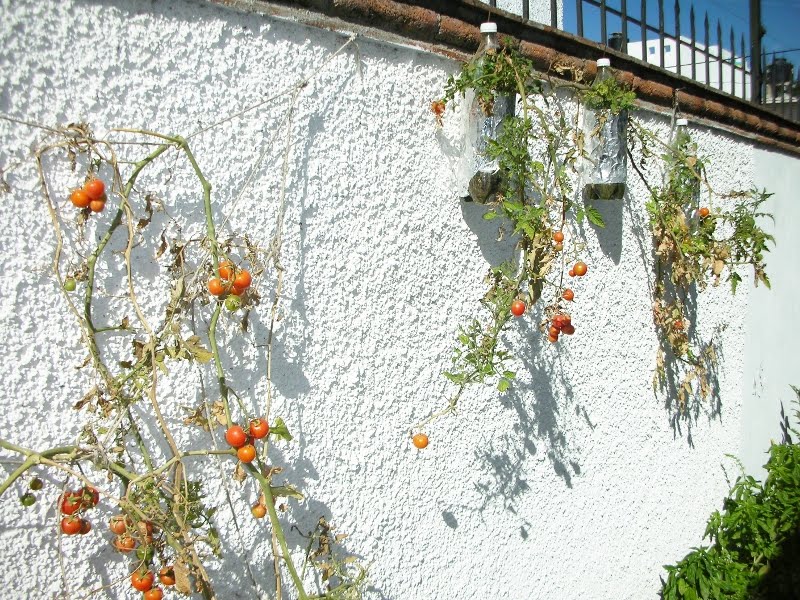
Today I harvested the last of the "jitomates cheri" (HEE-toh-mah-tays CHAIR-ee) or "cherry tomatoes" that I had planted early last spring. The tomato plants were still green but they were getting pretty scraggly and weren't producing many new tomatoes. It was definitely time for renewal. I had already started some new seedlings before Christmas from seeds taken from these same plants so all I had to do is pick the last of the ripe tomatoes, rip out the old plants, and replace them with their offspring. Isn't that more or less what life is all about anyway? The past year was a good year for cherry tomatoes. In fact, just about every year is a good year for these tasty little treats and that is why I like them so much. There is nothing like walking out on the patio and plucking a ripe tomato, and after rubbing it between your hands (or on your shirt like I do) to dust it off, you pop it in your mouth and squeeze it with your tongue until it explodes. The combination of the fresh tomato taste and aroma combined with the warmth of the sun makes you feel like you are tasting a bit the sun itself. Alongside the tomatoes I plant a lot of basil which is called "albahaca" (ahl-bah-AH-kah) is Spanish and the scent of the basil combined with the smell and taste of the tomato is just heavenly. Just thinking about it makes you sigh, don't it?
About six plants are all we need to supply ourselves and all of the relatives with cherry tomatoes and at the height of the season we will have tomatoes coming out of our ears. I grow some plants in large "macetas" (mah-SAY-tahs) which are clay flower pots about the size of a five gallon bucket and I grow some in large two or three liter plastic pop bottles that I hang on the garden wall. Other than regular watering and a bit of fertilizer now and then they need very little care. I am always starting new plants that I give away to friends and then listen to them rave about how many cherry tomatoes they are getting. There are two groups of people who love these tomatoes the most...little kids and old people. My "suegro" (SWAY-groh) or "father-in-law" and Gina's little "nieto" (NYET-oh) or "grandson" are always in competition to see who can pick the most tomatoes. I think that God must like cherry tomatoes too, and that is why He made them so delicious, prolific and easy to grow. Thank you God for loving us enough to share your cherry tomatoes with us. I love you back.


About six plants are all we need to supply ourselves and all of the relatives with cherry tomatoes and at the height of the season we will have tomatoes coming out of our ears. I grow some plants in large "macetas" (mah-SAY-tahs) which are clay flower pots about the size of a five gallon bucket and I grow some in large two or three liter plastic pop bottles that I hang on the garden wall. Other than regular watering and a bit of fertilizer now and then they need very little care. I am always starting new plants that I give away to friends and then listen to them rave about how many cherry tomatoes they are getting. There are two groups of people who love these tomatoes the most...little kids and old people. My "suegro" (SWAY-groh) or "father-in-law" and Gina's little "nieto" (NYET-oh) or "grandson" are always in competition to see who can pick the most tomatoes. I think that God must like cherry tomatoes too, and that is why He made them so delicious, prolific and easy to grow. Thank you God for loving us enough to share your cherry tomatoes with us. I love you back.


06 January 2011
Today is a special day.
Today, the sixth of January, is a special day for me. Today I celebrate my 12th anniversary of coming to Mexico. I had only intended to stay for a few months to help a friend named Federico Chio, but one thing led to another and I am still in Mexico. On the first few days of January back in 1999 a powerful winter storm had blasted the Chicago area from whence I came. All across Northern Illinois the storm had raged, dumping anywhere from nine to twenty-two inches of snow on the holiday traffic. The wind blew out of the northeast and it gusted well over thirty miles per hour causing considerable drifting. The storm set a Chicago record for the most snowfall in a single calendar day. Almost nineteen inches were recorded by the official weather reporting station at O'Hare Airport on Saturday, January the second. As if the snow and the wind weren't bad enough the temperature began to fall steadily. By Tuesday the fifth, the day I was hoping to leave for sunny Mexico, the temperature fell to more than ten below zero (Fahrenheit). It felt even colder because of the wind chill. My flight wasn't scheduled to leave until six thirty in the evening. During the blizzard everything came to a halt and many travelers had been stranded at the airport over the weekend.
By noon on Tuesday some semblance of order had been restored but the main problems were the cold and the wind. The unfortunate but valiant men and women of American Airlines, whose job it was to service the planes, were suffering terribly and could only remain outdoors for short periods. The airplanes had to be sprayed with de-icing solution before they could take off and the people who had to spray them with de-icer must have been super human. Once we finally took off about ten thirty, the three hour flight to Monterrey was relatively uneventful. I alternately read and dozed my way through the flight and as we made our approach to the Monterrey airport our pilot announced that the outside temperature was in the mid sixties. What a relief! I realized how miraculous it was that in just three hours I had been able to change my environment by going to a place where the air temperature was seventy five degrees higher than at the place I had left. It was a vivid reminder of the technology that we sometimes take for granted. I had never appreciated modern air travel more than I did that night.
I didn't get to bed until sometime after 2:am on the January 6th after arriving at the airport well after midnight. The next day I went to the shop where I would spend the next year working to help them obtain an international quality assurance certification. On the way to the shop we stopped to buy a couple "roscas" to share with the workers. I am referring to "la rosca de los reyes" or king's bread. It is an oval shaped loaf of sweet, twisted, fruit studded bread. Baked inside is a small ceramic or plastic figurine in the shape of a baby. The baby, of course, represents the Baby Jesus. It is a tradition for families, friends, class mates, or co-workers to gather together in mid to late afternoon for "la merienda" or afternoon snack to partake of the rosca on January 6th. My friend Federico called the workers together for the partaking of the rosca and took that opportunity to introduce me.
Before I left home I had asked Federico for a list of names of all of his workers, about thirty names in all. It is the custom in Mexico to use the father's last name followed by the mother's last name so including their first name, everyone has at least three segments to their full name and often four or sometimes even five. During the time that my plane sat on the ground in Chicago awaiting take off and later during the three hour flight to Monterrey I took it upon myself to memorize all of the names. This turned out to be a great idea which I realized soon after we reached the shop. I asked my friend to introduce me to his men using their first name only and I would fill in the rest of it. The result was magical. It produced instant smiles all around. The men were very impressed and I had a lot of fun breaking the ice that way. I discovered right then that names are very important in Mexico and it is a sign of great respect to remember them in full. From that point on I made it a habit to write down a person's name in a little notebook whenever I am being introduced to them. People don't seem seem to mind at all and because I meet so many people the help that this gives me later on is immeasurable.
It is customary for the person who receives the piece of rosca with the baby to give a party for everyone else on February second, the feast of "The Presentation of the Lord". As I was soon to find out, getting the piece of rosca with the baby hidden inside is not always considered good luck. Parties are expensive and despite the feeling of good fortune one might experience from discovering the baby more often than not the joy is partially canceled out by the realization that a party requires the expenditure of hard earned cash. It is natural for people to hang back, especially the males until someone else finds the baby. I was a little shocked that some of the more macho types referred to it as the "mono" or monkey. Once somebody finds the baby the rest are not so reluctant to dig in. For this reason people sometimes ask the baker to put two or more babies in the rosca. It catches some of those who have avoided having to give a party over the years and it is also a little easier on the pocketbook if there is more than one person to bear the cost of the party.
By the time the rosca ceremony was over I was completely exhausted and felt a sense of being overwhelmed by everything. However, before I drifted off to sleep later that night I reflected on all that had happened in the twenty four hours since I had left Chicago. I was dizzy with wonder of it all for it felt as if I had journeyed through a kaleidoscope. Little did I know that my adventures in Mexico had barely begun and the things to come in the next few weeks and months would make this first day seem average. That is one reason why the Epiphany, the Feast of the Three Kings, "Los Reyes Magos" is a very special day for me. That, and realizing so vividly how time flies when you are having fun. I love Mexico and I am very grateful to the Mexican people for all of their kindness to me.
¡ Viva México !
By noon on Tuesday some semblance of order had been restored but the main problems were the cold and the wind. The unfortunate but valiant men and women of American Airlines, whose job it was to service the planes, were suffering terribly and could only remain outdoors for short periods. The airplanes had to be sprayed with de-icing solution before they could take off and the people who had to spray them with de-icer must have been super human. Once we finally took off about ten thirty, the three hour flight to Monterrey was relatively uneventful. I alternately read and dozed my way through the flight and as we made our approach to the Monterrey airport our pilot announced that the outside temperature was in the mid sixties. What a relief! I realized how miraculous it was that in just three hours I had been able to change my environment by going to a place where the air temperature was seventy five degrees higher than at the place I had left. It was a vivid reminder of the technology that we sometimes take for granted. I had never appreciated modern air travel more than I did that night.
I didn't get to bed until sometime after 2:am on the January 6th after arriving at the airport well after midnight. The next day I went to the shop where I would spend the next year working to help them obtain an international quality assurance certification. On the way to the shop we stopped to buy a couple "roscas" to share with the workers. I am referring to "la rosca de los reyes" or king's bread. It is an oval shaped loaf of sweet, twisted, fruit studded bread. Baked inside is a small ceramic or plastic figurine in the shape of a baby. The baby, of course, represents the Baby Jesus. It is a tradition for families, friends, class mates, or co-workers to gather together in mid to late afternoon for "la merienda" or afternoon snack to partake of the rosca on January 6th. My friend Federico called the workers together for the partaking of the rosca and took that opportunity to introduce me.
Before I left home I had asked Federico for a list of names of all of his workers, about thirty names in all. It is the custom in Mexico to use the father's last name followed by the mother's last name so including their first name, everyone has at least three segments to their full name and often four or sometimes even five. During the time that my plane sat on the ground in Chicago awaiting take off and later during the three hour flight to Monterrey I took it upon myself to memorize all of the names. This turned out to be a great idea which I realized soon after we reached the shop. I asked my friend to introduce me to his men using their first name only and I would fill in the rest of it. The result was magical. It produced instant smiles all around. The men were very impressed and I had a lot of fun breaking the ice that way. I discovered right then that names are very important in Mexico and it is a sign of great respect to remember them in full. From that point on I made it a habit to write down a person's name in a little notebook whenever I am being introduced to them. People don't seem seem to mind at all and because I meet so many people the help that this gives me later on is immeasurable.
It is customary for the person who receives the piece of rosca with the baby to give a party for everyone else on February second, the feast of "The Presentation of the Lord". As I was soon to find out, getting the piece of rosca with the baby hidden inside is not always considered good luck. Parties are expensive and despite the feeling of good fortune one might experience from discovering the baby more often than not the joy is partially canceled out by the realization that a party requires the expenditure of hard earned cash. It is natural for people to hang back, especially the males until someone else finds the baby. I was a little shocked that some of the more macho types referred to it as the "mono" or monkey. Once somebody finds the baby the rest are not so reluctant to dig in. For this reason people sometimes ask the baker to put two or more babies in the rosca. It catches some of those who have avoided having to give a party over the years and it is also a little easier on the pocketbook if there is more than one person to bear the cost of the party.
By the time the rosca ceremony was over I was completely exhausted and felt a sense of being overwhelmed by everything. However, before I drifted off to sleep later that night I reflected on all that had happened in the twenty four hours since I had left Chicago. I was dizzy with wonder of it all for it felt as if I had journeyed through a kaleidoscope. Little did I know that my adventures in Mexico had barely begun and the things to come in the next few weeks and months would make this first day seem average. That is one reason why the Epiphany, the Feast of the Three Kings, "Los Reyes Magos" is a very special day for me. That, and realizing so vividly how time flies when you are having fun. I love Mexico and I am very grateful to the Mexican people for all of their kindness to me.
¡ Viva México !
02 January 2011
La Villa de Santa Georgina
Before I let the holiday slip away by I want to tell you about "La Villa de Santa Georgina". When I was a little boy in Chicago my great aunts Harrieta, Flavia, and Pelagia (Hattie, Flo, and Peggy) used to make a Christmas village every year at the base of the Christmas tree behind and to the sides of the nativity scene. The village that they made was quite detailed and spread out around base of the tree like a tiny community. Later on my sisters Suzanne (Suzy) and Kathryn (Kathy) carried on the tradition and Suzy's Christmas village in particular is realistic to the point of being spectacular. Of course, when my wife Gina learned about this she wanted one too and it just so happened that I came across some little ceramic houses of the Christmas style at Waldo's for only fifteen pesos each and I ended up buying a couple dozen. Then I made a little platform to hold the village and I covered it with unicél (oo-nee-SELL) which is what Styrofoam is called here in Mexico. I painted a background on a piece of plywood and attached it to the base. The whole thing sits below the counter of the arched divider that separates our kitchen area from our living room.
The name that I gave the village, "Santa Georgina", I took from real life. Gina's first name is actually "Georgina" and whenever she and her mother Carmelita start picking on me I start singing the litany of the saints in Latin in the old Gregorian chant style:
Sancta Georgina, ora pro nobis.
Saint Georgina, pray for us.
Sancta Carmelita, ora pro nobis.
Saint Carmelita, pray for us.
Ab omni malo, libera nos, Dómine.
From all evil, deliver us oh Lord.
This is just to remind them that they really aren't saints...YET!! I had a lot of fun working on this little project and I never really finished it because for one thing, I had too many supervisors. Fortunately, a good thing about Christmas is that "si Dios quiere" (if God is willing), it will come again next year and I can work on the village some more. My sisters have been working on theirs for almost forty years and they tell me that they are never quite finished. I guess the only time that when you are truly finished building a Christmas village is when you die. Anyway, I am pleased with the results so far even though it is one of the most eclectic Christmas villages that I have ever seen. That's okay though because everyone here seems to like it...especially "Santa" Georgina.
(Click to enlarge)


 "And I heard him exclaim as he drove out of sight, 'Happy Christmas to all, and to all a good night!'."
.
The name that I gave the village, "Santa Georgina", I took from real life. Gina's first name is actually "Georgina" and whenever she and her mother Carmelita start picking on me I start singing the litany of the saints in Latin in the old Gregorian chant style:
Sancta Georgina, ora pro nobis.
Saint Georgina, pray for us.
Sancta Carmelita, ora pro nobis.
Saint Carmelita, pray for us.
Ab omni malo, libera nos, Dómine.
From all evil, deliver us oh Lord.
This is just to remind them that they really aren't saints...YET!! I had a lot of fun working on this little project and I never really finished it because for one thing, I had too many supervisors. Fortunately, a good thing about Christmas is that "si Dios quiere" (if God is willing), it will come again next year and I can work on the village some more. My sisters have been working on theirs for almost forty years and they tell me that they are never quite finished. I guess the only time that when you are truly finished building a Christmas village is when you die. Anyway, I am pleased with the results so far even though it is one of the most eclectic Christmas villages that I have ever seen. That's okay though because everyone here seems to like it...especially "Santa" Georgina.
(Click to enlarge)


 "And I heard him exclaim as he drove out of sight, 'Happy Christmas to all, and to all a good night!'."
.
31 December 2010
My Word for MMXI
I have come to the point in my life where I need to decide whether to fall back into the bottomless depths of oblivion or to forge ahead into the raging storm of the future. At the end of this coming year I plan to retire from my present career at sixty-four and I need to decide if I am just going to pull the plug and wait for the "beeping" to stop or if I am going to sally forth and rage against the fading of the light by doing something new and different. New Year's Eve is the time when we traditionally take stock of our lives and and if we listen to our conscience and are honest with ourselves we attempt to make some adjustments. In the last few years I have limited my self to just a few resolutions and I am happy to report that I have been moderately successful in keeping them. This year, however, I have decided to reduce my resolutions even further to just one word that I can keep in front of me as a symbol for what I want to accomplish in 2011.
After careful consideration the English word that I have chosen is "ideate" (pronounced AHY-dee-aet) which is a verb that means "to form an idea of", "to think of", "to imagine" or "to conceive of". It is synonymous with "to dream", "to envision", "to fancy", to "fantasize", "to picture", "to visualize", "to conjure up", or "to see in your mind's eye". When used in the intransitive form (without an object) and in the imperative mood (command) it means:
THINK!
The thing that I really like about this word "ideate" is that it means the same thing in Spanish when you use the Spanish verb "idear" (ee-day-AHR) as a command although in the imperative it is written "idéate" (pronounced ee-DAY-ah-teh). When thinking about a symbol that would serve as a reminder of this word in both languages I chose the traditional incandescent light bulb because 130 year old invention has had such longevity as a symbol for fresh thinking. Then I had second thoughts about it because the incandescent bulb is no longer politically correct and the "green movement" that is so popular these days might take issue. I thought about using a spiral shaped CFL (Compact Fluorescent Lamp) as a symbol instead until I learned that the CFL isn't as environmentally friendly as it is purported to be. For one thing it contains mercury which eventually builds up in landfills with the potential to contaminate the air and water of millions of people. In fact, the only place where CFL's are presently manufactured is in China where they are made using very cheap labor and the pollution from the mercury is already making the poor workers sick. No...I think I will stick to the incandescent bulb as a symbol for an idea until something better comes down the pike. In the meantime I'll just "ideate" about it.
Happy New Year!

After careful consideration the English word that I have chosen is "ideate" (pronounced AHY-dee-aet) which is a verb that means "to form an idea of", "to think of", "to imagine" or "to conceive of". It is synonymous with "to dream", "to envision", "to fancy", to "fantasize", "to picture", "to visualize", "to conjure up", or "to see in your mind's eye". When used in the intransitive form (without an object) and in the imperative mood (command) it means:
THINK!
The thing that I really like about this word "ideate" is that it means the same thing in Spanish when you use the Spanish verb "idear" (ee-day-AHR) as a command although in the imperative it is written "idéate" (pronounced ee-DAY-ah-teh). When thinking about a symbol that would serve as a reminder of this word in both languages I chose the traditional incandescent light bulb because 130 year old invention has had such longevity as a symbol for fresh thinking. Then I had second thoughts about it because the incandescent bulb is no longer politically correct and the "green movement" that is so popular these days might take issue. I thought about using a spiral shaped CFL (Compact Fluorescent Lamp) as a symbol instead until I learned that the CFL isn't as environmentally friendly as it is purported to be. For one thing it contains mercury which eventually builds up in landfills with the potential to contaminate the air and water of millions of people. In fact, the only place where CFL's are presently manufactured is in China where they are made using very cheap labor and the pollution from the mercury is already making the poor workers sick. No...I think I will stick to the incandescent bulb as a symbol for an idea until something better comes down the pike. In the meantime I'll just "ideate" about it.
Happy New Year!

28 December 2010
Butter Fingers
The new year is coming upon us like "dry leaves before the hurricane fly" or like an Olympic speed skater gingerly crisscrossing his long legs through the last curve and tucking gracefully into a glide at the finish. As he crosses the finish line he straightens up, raises his arms over his head in victory, and shouts "Happy New Year" while everyone cheers and the old year fades into memory. Before the old year vanishes completely it always seems apropos to spend some time in reflection to see what one may have learned, if anything, ignoring the advice of Sachel Page, the famous baseball pitcher, who said, "Don't look back. Something might be gaining on you."
What have I learned over the past year? Not much to write about I'm afraid. I learned that sometimes you're hot and sometimes you're not. I learned that much of what people admire as "success" is none other than the luck of the draw. I learned that gratitude is the least deeply held of human emotions. I learned that democracy is more or less one big cat fight. I learned that greed is not enough to maintain a stable economy. I learned that conspicuous consumption is a path to disaster. What I have especially learned by living in Mexico, however, is to live for the moment, neither fretting about the past nor worrying too much about the future. I accept life as an adventurous journey that eventually ends in a death which I will embrace wholeheartedly when the time comes. I look at death as yet another adventure that will be more interesting and more rewarding than this present state of being that we call "life" and I trust that there is a just and merciful God on Heaven to whom I commend my spirit.
When I was a kid life was much simpler. There didn't seem to be as many rules as there are today...rules that are often confusing and conflicting and that no one has the time to study, much less understand. In Chicago where I was born and raised we played sixteen inch softball as they still do there and also in St. Louis. It is a great game because all you need is a bat and a ball and you can play it on small lots and it is "slow pitch" so everybody can play together, boys and girls, young and old. When we would choose up sides for a game we would call out the rules. If there weren't enough players we would call "right field is out" so we wouldn't need a right fielder (Sorry lefties. Deal with it.) If we were still short a player we would call out "pitchers hands are out" meaning that the runner had to reach first base before the ball got back to the pitcher. Then we made the rules for home runs, automatic doubles, etc. Most of the time the rules were pretty much the same and only needed some minor tweaking. The person who owned the bat and the ball had the final say. We were all umpires collectively and there was no cheating lest the player who owned the ball or the bat would retrieve his or her equipment and go home, thus ending the game. We even had a game called "piggy move up" when there really weren't enough players to field two full teams. Ahhh, life was good.
I remember that we had a term that we used when someone dropped the ball. We would all shout "butterfingers" to the chagrin of the person who dropped it and everybody would smile and laugh. Everyone dropped the ball at some time or other so it was all in good fun. I haven't heard the term "butterfingers" in a long, long time and I wonder why. I have a book of poetry titled "Be the Best of Whatever You Are" that was written in 1926 by a wonderful man named Douglas Malloch. The book was passed down to me through relatives and the original belonged to the granddaughter of my great aunt Harriet Turalski. The young girl died of cancer at age twelve but everyone who knew her said that she had a wonderful disposition and they all loved her. Her name was Dolores French and this was her favorite book. It just so happened that one of the poems is called "Butter Fingers".
Butter Fingers
by Douglas Malloch
When we played at one old cat,
Or chose up sides, and things like that,
There were days we dropped the ball,
Couldn't make an out at all.
Don't know why, we couldn't tell,
But oh how all the kids would yell,
"Butter fingers."
Other days we captured flies,
Tagged out runners twice our size,
Caught the pitcher's outs and drops,
Made those great one-handed stops,
Didn't seem to miss a thing,
Never heard a critic sing,
"Butter fingers."
But, I might as well confess,
We didn't know and couldn't guess,
Never really understood,
Why our game was bad or good--
Why we played our best today,
Yet tomorrow heard them say,
"Butter fingers."
That's the reason, in the game
Men call life, I'm slow to blame
Those who fumble this or that,
Be it life or one old cat.
Just remember, when they fall,
Days that you yourself were all
"Butter fingers."
(Bob's note: "One Old Cat" was one of the forerunners to modern baseball)
If you have followed me this far I want to wish you health and happiness in the new year and even though there maybe times when you are all "butter fingers" just remember to take it in stride and keep peace in your heart.
What have I learned over the past year? Not much to write about I'm afraid. I learned that sometimes you're hot and sometimes you're not. I learned that much of what people admire as "success" is none other than the luck of the draw. I learned that gratitude is the least deeply held of human emotions. I learned that democracy is more or less one big cat fight. I learned that greed is not enough to maintain a stable economy. I learned that conspicuous consumption is a path to disaster. What I have especially learned by living in Mexico, however, is to live for the moment, neither fretting about the past nor worrying too much about the future. I accept life as an adventurous journey that eventually ends in a death which I will embrace wholeheartedly when the time comes. I look at death as yet another adventure that will be more interesting and more rewarding than this present state of being that we call "life" and I trust that there is a just and merciful God on Heaven to whom I commend my spirit.
When I was a kid life was much simpler. There didn't seem to be as many rules as there are today...rules that are often confusing and conflicting and that no one has the time to study, much less understand. In Chicago where I was born and raised we played sixteen inch softball as they still do there and also in St. Louis. It is a great game because all you need is a bat and a ball and you can play it on small lots and it is "slow pitch" so everybody can play together, boys and girls, young and old. When we would choose up sides for a game we would call out the rules. If there weren't enough players we would call "right field is out" so we wouldn't need a right fielder (Sorry lefties. Deal with it.) If we were still short a player we would call out "pitchers hands are out" meaning that the runner had to reach first base before the ball got back to the pitcher. Then we made the rules for home runs, automatic doubles, etc. Most of the time the rules were pretty much the same and only needed some minor tweaking. The person who owned the bat and the ball had the final say. We were all umpires collectively and there was no cheating lest the player who owned the ball or the bat would retrieve his or her equipment and go home, thus ending the game. We even had a game called "piggy move up" when there really weren't enough players to field two full teams. Ahhh, life was good.
I remember that we had a term that we used when someone dropped the ball. We would all shout "butterfingers" to the chagrin of the person who dropped it and everybody would smile and laugh. Everyone dropped the ball at some time or other so it was all in good fun. I haven't heard the term "butterfingers" in a long, long time and I wonder why. I have a book of poetry titled "Be the Best of Whatever You Are" that was written in 1926 by a wonderful man named Douglas Malloch. The book was passed down to me through relatives and the original belonged to the granddaughter of my great aunt Harriet Turalski. The young girl died of cancer at age twelve but everyone who knew her said that she had a wonderful disposition and they all loved her. Her name was Dolores French and this was her favorite book. It just so happened that one of the poems is called "Butter Fingers".
Butter Fingers
by Douglas Malloch
When we played at one old cat,
Or chose up sides, and things like that,
There were days we dropped the ball,
Couldn't make an out at all.
Don't know why, we couldn't tell,
But oh how all the kids would yell,
"Butter fingers."
Other days we captured flies,
Tagged out runners twice our size,
Caught the pitcher's outs and drops,
Made those great one-handed stops,
Didn't seem to miss a thing,
Never heard a critic sing,
"Butter fingers."
But, I might as well confess,
We didn't know and couldn't guess,
Never really understood,
Why our game was bad or good--
Why we played our best today,
Yet tomorrow heard them say,
"Butter fingers."
That's the reason, in the game
Men call life, I'm slow to blame
Those who fumble this or that,
Be it life or one old cat.
Just remember, when they fall,
Days that you yourself were all
"Butter fingers."
(Bob's note: "One Old Cat" was one of the forerunners to modern baseball)
If you have followed me this far I want to wish you health and happiness in the new year and even though there maybe times when you are all "butter fingers" just remember to take it in stride and keep peace in your heart.


19 December 2010
Navidad 2010
Every year I write a bit about the Christmas activities here in Central Mexico and especially about the Posadas and Pastorellas. This is not only to inform those who may be newcomers to Mexico or others who may be interested but also to refresh my own memory. Each year I learn more and more about the traditions of the Mexican Christmas and I have the opportunity to add a little more information to my blog and to make corrections.
There are three main themes including the Posada, the Piñata, and the Pastorela that climax on December 24th which is called “Nochebuena” or the “Good Night”. First I will address the “Posada” which means “lodging”. It relates the story of Saint Joseph leading a donkey bearing the very pregnant Virgin Mary from their home in Nazareth to Bethlehem where Joseph frantically searched for a place where Mary could give birth to the Baby Jesus. Beginning on December 16th and continuing up to and including December 24th the posadas are held each night in turn by different people of the same neighborhood or family. This is a nine day period called a “novena” and some say that it commemorates the nine months that Mary was pregnant and others say that it commemorates the journey from Nazareth to Jerusalem, which supposedly took nine days. In the time of Jesus many societies followed the custom of gathering together for nine days following a burial and in the new testament book “The Acts of the Apostles” (Acts 1:14), we find the apostles, along with some of the close disciples and Mary the mother of Jesus gathered in the upper room and praying for nine consecutive days which culminated in the Pentecost or decent of the Holy Spirit upon them. In any case, nine seems to be a significant number in ancient histories.
How the posadas got started in Mexico is an interesting story. In the year 1587 a priest named Fray Diego de Soria, who was the rector of a monastery called San Augustín de Alcoman (just to the northeast Mexico City), asked permission to celebrate a mass called the “Misa de Aguinaldos” (Mass of Gifts) each day from December 16th to December 24th. In this mass there would be passages related to the story of the nativity and in order to draw the people to the mass the priests would include entertainment in the form of fireworks and songs and little gifts in the form of sweets. Now it just so happens that the people were already accustomed to celebrating during this period of winter solstice which they called “Panquetzaliztli” in their native tongue. It was a time when they celebrated their native war god whom they called “Huitzilopochtli”. The feast of Huitzilpochtli lasted twenty days from the 6th of December until the 26th and it also had an element of pilgrimage in that people would travel long distances to come join the celebration. They would also receive gifts of sweetened seedcakes of amaranth or in Spanish “amaranto” and these sweets are still around today and are called “dulce de alegria” or “candy of joy”. Also note that even to the present day, the little bags of sweets given to children at Navidad are called “aguinaldo” and the same word is used for the end of the year bonus pay that is traditionally given to workers just before Navidad.
The earliest posadas were held in the open courtyards of the monasteries and began with a recitation of the rosary accompanied by songs and stories based upon the biblical account of the birth of Christ. Later on, the posadas were carried over by the people to their own houses and neighborhoods and evolved into what they are today. The posada entails two groups, one representing the innkeepers and the other representing the “peregrinos” or “pilgrims” meaning Joseph and Mary. All of the people in the pilgrim group carry candles and usually four of them carry a litter instead, upon which rest statues of Joseph and Mary and a donkey. Sometimes this is actually substituted by people dressed as Joseph and Mary and Mary is seated on a real donkey! There is generally someone walking in front of the group with a paper lantern lit by a candle. As is the custom they go to three houses and at each they knock on the door and sing their request for lodging. At the first two houses the group who answers the door listens to their request and sings a refusal. At the third house they sing their request to enter and the participants in the house give their acceptance in song and all of the people including the people from the other two houses are let in. Then they recite a rosary and sing a litany to the Virgin Mary and after this the fun begins. One of the things that they do which really surprised me is that everyone lights “sparklers” which in the United States people traditionally light on the 4th of July. The ones that they use in Mexico for the posadas, however, are much smaller. They are called either “Luces de Belén” (Lights of Bethlehem) or “Luces de Bengala” (Lights of India). Even the small children get into the act and I am always worried that one of them will get burned but thank God I haven’t ever seen that happen and I hope I never will.
Now it is time to talk about the Piñata. The origin of the piñata can be traced back to China and it was part of the Chinese Spring Festival or what people in the west call “Chinese New Year”. The custom came to Italy by means of Marco Polo or perhaps some other adventurous soul and in Italy it took on a religious aspect and was called a “pignatta. It was used during the Lenten period and when the custom of breaking piñatas during Lent eventually arrived in Spain the Spanish introduced a feast every first Sunday of Lent called "The Dance of the Piñata." Breaking the piñata at the beginning of Lent symbolized the desire to end the evil in one's life, to convert the heart to return to God and receive an eternal reward. In the early sixteenth century, the piñata tradition was unknown in the New World but in Mexico, the Mayan Indians had a tradition of trying to break a clay pot that was filled with sweets and balanced on a pole. This practice was part of the traditional December “Panquetzaliztli” celebrations in honor of their war god “Huitzilopochtli”. The Spanish missionary priests were always looking for ways to convert the native traditions to Christian traditions and so they gave a religious sense to the game of breaking the pot and so they converted the “pot” into the form of the Spanish/Italian “piñata” and moved it from Lent to Advent. It quickly became a popular compliment to the festivities of the Posadas.
The traditional piñata of Navidad is made from a clay pot called an “olla piñatera” or “cantero” that is covered with bright colored paper and represents the Devil who tempts us with the bright colors. The classic piñata of Navidad is round with seven peaks or spikes, representing the seven cardinal sins: Sloth, Lust, Greed, Envy, Gluttony, Wrath, and Pride. Hitting the piñata while blindfolded represents faith that allows us to believe without seeing. The stick with which to beat the piñata represents the force of the grace of God with which we combat evil. With God's help, we destroy the evil, and then we receive the fruits of God’s reward which are the sweets that are contained in the piñata. The shouts of the people who guide the blindfolded person with the stick represent the faithful of the church who collectively help us combat the Devil and who also share in God’s reward when the Devil is overcome.
The breaking of the piñata is always the highlight of any celebration. There are some very traditional songs that are sung in the process of breaking the piñata and during Navidad there are some extra phrases that are sung back and forth by the participants prior to the actual attempts to break the piñata:
Ándale Roberto, no te dilates con la canasta de los cacahuates.
(Hurry up Robert, don’t dilly dally with the basket of peanuts.)
Ándale Gina, sal del rincón con la canasta de colación.
(Hurry up Gina, come out of the corner with the basket of sweets.)
Note: The word "colación" (koh-lah-SEEOHN) can mean several things. It can mean a convocation of religious monks or it can refer to an ancient legal term pertaining to the rights of inheritance. It can mean an "aperitif" (appetizer) or it can also mean "sweetmeats" given to servants on Christmas Eve. In Mexico it usually means "refrigerios" (rey-free-HAIR-eeohs) or "treats" that are generally little pieces of hard sugar candy. They come in a variety of shapes and colors and sizes. When sugar syrup is heated it passes through various stages or taste and texture and can be made into different types of candies depending upon the highest temperature that is reached. The temperature range is from about 235 degrees Fahrenheit up to about 350 degrees. In the old days people didn't have thermometers so they judged the candy by heating the syrup and then dropping a spoonful into cold water and judging by the form it took as to whether or not it had reached the right temperature. Then they added flavors like "hinojo" (fennel), "hierbabuena" (peppermint), and "anis" (anise). They also colored the candy by adding vegetable dyes and they might put nuts like peanuts or almonds at the center. There are about three hundred different examples of Mexican hard candies in the historical records. Many of them were invented and produced by nuns in the convent kitchens. Kids don't care for them much anymore and end up throwing them at each other but the old folks always like to have some around at Christmas just for old time sake.
No quiero oro ni quiero plata, yo lo que quiero romper la piñata.
(I don’t want gold nor do I want silver, I just want to break the piñata.)
En esta posada salimos de apuro porque Luis nos dio solo ponte duro.
(We are leaving this posada early because Luis only gave us ponte duro.)
Note: “ponte duro” are hardened little balls of corn flour mixed with unrefined sugar…a poor substitute for candy.
Ándale José, mueve los pies con los copitas de vino jerez.
(Hurry up Joseph, move your feet, and bring us cups of sherry wine.)
Esta piñata es de muchas mañas, solo contiene naranjas y cañas.
(This piñata is a trick; it only contains oranges and sugar cane.)
Quiero mi canasta de papel de china, si no me la das me voy a la esquina.
(I want my tissue paper basket; if you don’t give it to me I will go out to the street corner.)
Note: the basket referred to is the “aguinaldo” or gift basket of goodies which is given to everyone who attends the posada to make sure that no one is left out. The baskets are commonly made from or lined with either tissue paper, crepe paper, or white butcher paper.
Quiero mi canasta de papel crepe, si no me la das me voy con José.
(I want my crepe paper basket; if you don’t give it to me I am going over to José’s house.)
Quiero mi canasta de papel estraza, si me no la das me voy a mi casa.
(I want my butcher paper basket; if you don’t give it to me I am going home.)
En esta posada nos hemos chasqueado porque Teresita nada nos ha dado.
(We are very upset with this posada because little Teresa didn’t give us anything.)
Echen confites y canelones a los muchachos que son muy tragones.
(Throw hard candies at the boys who grab for too much.)
Note: “Confites and Canelones” are two types of hard candy.
Todos los muchachos rezaron con devoción, de chochos y confites les dan ya su ración.
(All of the boys prayed with devotion so let’s give them their share of lupin beans and hard candies.)
Note: “Chochos” or “Lupin Beans” are like salted nuts and in Spain they are called “altramuz”.
Castaña asada, piña cubierta; ¡Echen a palos a los de la puerta!
(Roasted chestnuts and candied pineapple; hit with a stick the people who are blocking our way!)
Ándale Juan, sal de la hornilla, con la botella de la manzanilla.
(Hurry up Juan from the corner by the oven with the bottle of manzanilla wine.)
De los cerritos y los cerrotes, saltan y brincan los tejocotes.
(From the little hills and big hills the tejocotes jump and skip.)
Note: “Tejocotes” are a yellow fruit about the size of a plum that grow wild and are used for fruit punch especially at Navidad.
Ándale niña, sal otra vez, con la botella de vino jerez.
(Hurry up little girl, bring the bottle of sherry wine once again.)
Esta posada le toca a Carmela, si no da nada le saca una muela.
(This posada is Carmen’s turn, if she doesn’t give anything she forfeits a tooth.)
Ándale Mari no peles los dientes, yo lo que quiero son ponches calientes.
(Hurry up Mary, don’t give a silly grin, what I want is hot fruit punch.)
Todaditos muy contentos a rezar la posadita, no es tanta devoción si no por la canasta.
(Everyone is content to participate in the posada, not so much for devotion as for the basket of goodies.)
Ahora si muchachos ya se puede ir, para que mañana los dejen venir.
(Okay boys, you can go home now because tomorrow you can come again.)
After the above calls back and forth the children line up stating with the smallest on to the biggest and the first person is given the stick (usually a sawed off broom stick or mop handle). Many times the first person is actually a baby who is held in the arms of his mother and this is the baby’s first ritual introduction to the piñata. The first person who is old enough to act on their own is blind folded and then spun in a circle while the people sing:
Ya se va el curo Ponciano con su bastón en su mano a ver si vuelta u vuelta se quita lo panzón.
(There goes the priest Ponciano with his stick in his hand to see if by turning and turning around he can lose his belly.)
Then the blindfolded person is left under the piñata to try and find it and hit it with the stick. Some people pull on the rope that supports the piñata to make it jump about and harder to hit. Other people shout directions and encouragement while some of the people sing the following ditty to set a time limit:
Dale, dale, dale,
No pierdas el tino
Porque si lo pierdes
Pierdes el camino.
Dale, dale, dale
Dale y no le dio
Quítenle la venda
¡Porque sigo yo!
¡Se Acabó!
¡Sigo yo!
(Hit it, hit it, hit it!
Don't lose your aim
Because if you lose your aim
You will lose the path.
Hit it, hit it, hit it!
He [or she] hit it, and it didn't give
Take away his blindfold
Because it's now my turn!
It’s over!
I'm next!)
Note: There are several versions and the last part of one version goes like this:
Ya le diste uno,
Ya le diste dos,
Ya le diste tres,
Y tu tiempo se acabo!
(You already gave it one hit,
You already gave it two hits,
You already gave it three hits
And your time is up!)
The people take turns until the piñata is broken and the treats come showering down and everyone scrambles to retrieve what the can. Often as not the piñata is finally broken by some twelve or thirteen year old girl who by now is a veteran of many attempts and knows exactly what strategies are needed to outsmart the jumping target. It is always interesting how exited the people get at the sight of the piñata. You can actually see grown people, especially young women, trembling with excitement as if wishing that they could take a turn. The piñata, however, is mostly reserved for children. After the scramble for goodies is over everyone receives a little bag of treats (aguinaldo) to make sure that no one is left out.
Now we come to the Pastorela or “Shepherd’s Play”. A pastorela is a simple morality play that usually involves shepherds who in some way or another are being tempted or tormented by the Devil. They began in twelfth century Europe and appeared in Mexico in the middle of the sixteenth century. They were used initially for the purpose of the evangelization of the native people but they eventually became part of the tradition of Navidad especially among school children. Many pastorelas are performed in schools or in community cultural centers. Almost every town of any size in Mexico has a “Casa de la Cultura” and putting on a pastorela performance is one of their traditions at Navidad. Pastorelas are homey, involve many children, and are at the same time quite predictable and very often amusing. The cast of characters has parts for everyone including simple shepherds, various Devils, Angels, Archangels, oriental Kings, and the Holy Family. Navidad just wouldn’t be the same without a pastorela. It is part of the fabric of Mexican culture.
One final note: The translations from Spanish to English above are my own. I have done the best that I can to convey the meaning but the translations are by no means literal. Some of the Spanish words are archaic and are not normally used in common speech and many of the phrases are linked to cultural practices which are no longer in use. When I asked some of my Mexican friends to help me with the translations they gave only a vague meaning for some of the words. I had to do bit of research to ferret out the details and even then when translated literally and out of cultural context the words didn’t make much sense in English without much additional explanation. What I provided above is what I consider to be a good compromise. Please cut me some slack if you don't agree and let me hear from you.
¡ Feliz Navidad !


There are three main themes including the Posada, the Piñata, and the Pastorela that climax on December 24th which is called “Nochebuena” or the “Good Night”. First I will address the “Posada” which means “lodging”. It relates the story of Saint Joseph leading a donkey bearing the very pregnant Virgin Mary from their home in Nazareth to Bethlehem where Joseph frantically searched for a place where Mary could give birth to the Baby Jesus. Beginning on December 16th and continuing up to and including December 24th the posadas are held each night in turn by different people of the same neighborhood or family. This is a nine day period called a “novena” and some say that it commemorates the nine months that Mary was pregnant and others say that it commemorates the journey from Nazareth to Jerusalem, which supposedly took nine days. In the time of Jesus many societies followed the custom of gathering together for nine days following a burial and in the new testament book “The Acts of the Apostles” (Acts 1:14), we find the apostles, along with some of the close disciples and Mary the mother of Jesus gathered in the upper room and praying for nine consecutive days which culminated in the Pentecost or decent of the Holy Spirit upon them. In any case, nine seems to be a significant number in ancient histories.
How the posadas got started in Mexico is an interesting story. In the year 1587 a priest named Fray Diego de Soria, who was the rector of a monastery called San Augustín de Alcoman (just to the northeast Mexico City), asked permission to celebrate a mass called the “Misa de Aguinaldos” (Mass of Gifts) each day from December 16th to December 24th. In this mass there would be passages related to the story of the nativity and in order to draw the people to the mass the priests would include entertainment in the form of fireworks and songs and little gifts in the form of sweets. Now it just so happens that the people were already accustomed to celebrating during this period of winter solstice which they called “Panquetzaliztli” in their native tongue. It was a time when they celebrated their native war god whom they called “Huitzilopochtli”. The feast of Huitzilpochtli lasted twenty days from the 6th of December until the 26th and it also had an element of pilgrimage in that people would travel long distances to come join the celebration. They would also receive gifts of sweetened seedcakes of amaranth or in Spanish “amaranto” and these sweets are still around today and are called “dulce de alegria” or “candy of joy”. Also note that even to the present day, the little bags of sweets given to children at Navidad are called “aguinaldo” and the same word is used for the end of the year bonus pay that is traditionally given to workers just before Navidad.
The earliest posadas were held in the open courtyards of the monasteries and began with a recitation of the rosary accompanied by songs and stories based upon the biblical account of the birth of Christ. Later on, the posadas were carried over by the people to their own houses and neighborhoods and evolved into what they are today. The posada entails two groups, one representing the innkeepers and the other representing the “peregrinos” or “pilgrims” meaning Joseph and Mary. All of the people in the pilgrim group carry candles and usually four of them carry a litter instead, upon which rest statues of Joseph and Mary and a donkey. Sometimes this is actually substituted by people dressed as Joseph and Mary and Mary is seated on a real donkey! There is generally someone walking in front of the group with a paper lantern lit by a candle. As is the custom they go to three houses and at each they knock on the door and sing their request for lodging. At the first two houses the group who answers the door listens to their request and sings a refusal. At the third house they sing their request to enter and the participants in the house give their acceptance in song and all of the people including the people from the other two houses are let in. Then they recite a rosary and sing a litany to the Virgin Mary and after this the fun begins. One of the things that they do which really surprised me is that everyone lights “sparklers” which in the United States people traditionally light on the 4th of July. The ones that they use in Mexico for the posadas, however, are much smaller. They are called either “Luces de Belén” (Lights of Bethlehem) or “Luces de Bengala” (Lights of India). Even the small children get into the act and I am always worried that one of them will get burned but thank God I haven’t ever seen that happen and I hope I never will.
Now it is time to talk about the Piñata. The origin of the piñata can be traced back to China and it was part of the Chinese Spring Festival or what people in the west call “Chinese New Year”. The custom came to Italy by means of Marco Polo or perhaps some other adventurous soul and in Italy it took on a religious aspect and was called a “pignatta. It was used during the Lenten period and when the custom of breaking piñatas during Lent eventually arrived in Spain the Spanish introduced a feast every first Sunday of Lent called "The Dance of the Piñata." Breaking the piñata at the beginning of Lent symbolized the desire to end the evil in one's life, to convert the heart to return to God and receive an eternal reward. In the early sixteenth century, the piñata tradition was unknown in the New World but in Mexico, the Mayan Indians had a tradition of trying to break a clay pot that was filled with sweets and balanced on a pole. This practice was part of the traditional December “Panquetzaliztli” celebrations in honor of their war god “Huitzilopochtli”. The Spanish missionary priests were always looking for ways to convert the native traditions to Christian traditions and so they gave a religious sense to the game of breaking the pot and so they converted the “pot” into the form of the Spanish/Italian “piñata” and moved it from Lent to Advent. It quickly became a popular compliment to the festivities of the Posadas.
The traditional piñata of Navidad is made from a clay pot called an “olla piñatera” or “cantero” that is covered with bright colored paper and represents the Devil who tempts us with the bright colors. The classic piñata of Navidad is round with seven peaks or spikes, representing the seven cardinal sins: Sloth, Lust, Greed, Envy, Gluttony, Wrath, and Pride. Hitting the piñata while blindfolded represents faith that allows us to believe without seeing. The stick with which to beat the piñata represents the force of the grace of God with which we combat evil. With God's help, we destroy the evil, and then we receive the fruits of God’s reward which are the sweets that are contained in the piñata. The shouts of the people who guide the blindfolded person with the stick represent the faithful of the church who collectively help us combat the Devil and who also share in God’s reward when the Devil is overcome.
The breaking of the piñata is always the highlight of any celebration. There are some very traditional songs that are sung in the process of breaking the piñata and during Navidad there are some extra phrases that are sung back and forth by the participants prior to the actual attempts to break the piñata:
Ándale Roberto, no te dilates con la canasta de los cacahuates.
(Hurry up Robert, don’t dilly dally with the basket of peanuts.)
Ándale Gina, sal del rincón con la canasta de colación.
(Hurry up Gina, come out of the corner with the basket of sweets.)
Note: The word "colación" (koh-lah-SEEOHN) can mean several things. It can mean a convocation of religious monks or it can refer to an ancient legal term pertaining to the rights of inheritance. It can mean an "aperitif" (appetizer) or it can also mean "sweetmeats" given to servants on Christmas Eve. In Mexico it usually means "refrigerios" (rey-free-HAIR-eeohs) or "treats" that are generally little pieces of hard sugar candy. They come in a variety of shapes and colors and sizes. When sugar syrup is heated it passes through various stages or taste and texture and can be made into different types of candies depending upon the highest temperature that is reached. The temperature range is from about 235 degrees Fahrenheit up to about 350 degrees. In the old days people didn't have thermometers so they judged the candy by heating the syrup and then dropping a spoonful into cold water and judging by the form it took as to whether or not it had reached the right temperature. Then they added flavors like "hinojo" (fennel), "hierbabuena" (peppermint), and "anis" (anise). They also colored the candy by adding vegetable dyes and they might put nuts like peanuts or almonds at the center. There are about three hundred different examples of Mexican hard candies in the historical records. Many of them were invented and produced by nuns in the convent kitchens. Kids don't care for them much anymore and end up throwing them at each other but the old folks always like to have some around at Christmas just for old time sake.
No quiero oro ni quiero plata, yo lo que quiero romper la piñata.
(I don’t want gold nor do I want silver, I just want to break the piñata.)
En esta posada salimos de apuro porque Luis nos dio solo ponte duro.
(We are leaving this posada early because Luis only gave us ponte duro.)
Note: “ponte duro” are hardened little balls of corn flour mixed with unrefined sugar…a poor substitute for candy.
Ándale José, mueve los pies con los copitas de vino jerez.
(Hurry up Joseph, move your feet, and bring us cups of sherry wine.)
Esta piñata es de muchas mañas, solo contiene naranjas y cañas.
(This piñata is a trick; it only contains oranges and sugar cane.)
Quiero mi canasta de papel de china, si no me la das me voy a la esquina.
(I want my tissue paper basket; if you don’t give it to me I will go out to the street corner.)
Note: the basket referred to is the “aguinaldo” or gift basket of goodies which is given to everyone who attends the posada to make sure that no one is left out. The baskets are commonly made from or lined with either tissue paper, crepe paper, or white butcher paper.
Quiero mi canasta de papel crepe, si no me la das me voy con José.
(I want my crepe paper basket; if you don’t give it to me I am going over to José’s house.)
Quiero mi canasta de papel estraza, si me no la das me voy a mi casa.
(I want my butcher paper basket; if you don’t give it to me I am going home.)
En esta posada nos hemos chasqueado porque Teresita nada nos ha dado.
(We are very upset with this posada because little Teresa didn’t give us anything.)
Echen confites y canelones a los muchachos que son muy tragones.
(Throw hard candies at the boys who grab for too much.)
Note: “Confites and Canelones” are two types of hard candy.
Todos los muchachos rezaron con devoción, de chochos y confites les dan ya su ración.
(All of the boys prayed with devotion so let’s give them their share of lupin beans and hard candies.)
Note: “Chochos” or “Lupin Beans” are like salted nuts and in Spain they are called “altramuz”.
Castaña asada, piña cubierta; ¡Echen a palos a los de la puerta!
(Roasted chestnuts and candied pineapple; hit with a stick the people who are blocking our way!)
Ándale Juan, sal de la hornilla, con la botella de la manzanilla.
(Hurry up Juan from the corner by the oven with the bottle of manzanilla wine.)
De los cerritos y los cerrotes, saltan y brincan los tejocotes.
(From the little hills and big hills the tejocotes jump and skip.)
Note: “Tejocotes” are a yellow fruit about the size of a plum that grow wild and are used for fruit punch especially at Navidad.
Ándale niña, sal otra vez, con la botella de vino jerez.
(Hurry up little girl, bring the bottle of sherry wine once again.)
Esta posada le toca a Carmela, si no da nada le saca una muela.
(This posada is Carmen’s turn, if she doesn’t give anything she forfeits a tooth.)
Ándale Mari no peles los dientes, yo lo que quiero son ponches calientes.
(Hurry up Mary, don’t give a silly grin, what I want is hot fruit punch.)
Todaditos muy contentos a rezar la posadita, no es tanta devoción si no por la canasta.
(Everyone is content to participate in the posada, not so much for devotion as for the basket of goodies.)
Ahora si muchachos ya se puede ir, para que mañana los dejen venir.
(Okay boys, you can go home now because tomorrow you can come again.)
After the above calls back and forth the children line up stating with the smallest on to the biggest and the first person is given the stick (usually a sawed off broom stick or mop handle). Many times the first person is actually a baby who is held in the arms of his mother and this is the baby’s first ritual introduction to the piñata. The first person who is old enough to act on their own is blind folded and then spun in a circle while the people sing:
Ya se va el curo Ponciano con su bastón en su mano a ver si vuelta u vuelta se quita lo panzón.
(There goes the priest Ponciano with his stick in his hand to see if by turning and turning around he can lose his belly.)
Then the blindfolded person is left under the piñata to try and find it and hit it with the stick. Some people pull on the rope that supports the piñata to make it jump about and harder to hit. Other people shout directions and encouragement while some of the people sing the following ditty to set a time limit:
Dale, dale, dale,
No pierdas el tino
Porque si lo pierdes
Pierdes el camino.
Dale, dale, dale
Dale y no le dio
Quítenle la venda
¡Porque sigo yo!
¡Se Acabó!
¡Sigo yo!
(Hit it, hit it, hit it!
Don't lose your aim
Because if you lose your aim
You will lose the path.
Hit it, hit it, hit it!
He [or she] hit it, and it didn't give
Take away his blindfold
Because it's now my turn!
It’s over!
I'm next!)
Note: There are several versions and the last part of one version goes like this:
Ya le diste uno,
Ya le diste dos,
Ya le diste tres,
Y tu tiempo se acabo!
(You already gave it one hit,
You already gave it two hits,
You already gave it three hits
And your time is up!)
The people take turns until the piñata is broken and the treats come showering down and everyone scrambles to retrieve what the can. Often as not the piñata is finally broken by some twelve or thirteen year old girl who by now is a veteran of many attempts and knows exactly what strategies are needed to outsmart the jumping target. It is always interesting how exited the people get at the sight of the piñata. You can actually see grown people, especially young women, trembling with excitement as if wishing that they could take a turn. The piñata, however, is mostly reserved for children. After the scramble for goodies is over everyone receives a little bag of treats (aguinaldo) to make sure that no one is left out.
Now we come to the Pastorela or “Shepherd’s Play”. A pastorela is a simple morality play that usually involves shepherds who in some way or another are being tempted or tormented by the Devil. They began in twelfth century Europe and appeared in Mexico in the middle of the sixteenth century. They were used initially for the purpose of the evangelization of the native people but they eventually became part of the tradition of Navidad especially among school children. Many pastorelas are performed in schools or in community cultural centers. Almost every town of any size in Mexico has a “Casa de la Cultura” and putting on a pastorela performance is one of their traditions at Navidad. Pastorelas are homey, involve many children, and are at the same time quite predictable and very often amusing. The cast of characters has parts for everyone including simple shepherds, various Devils, Angels, Archangels, oriental Kings, and the Holy Family. Navidad just wouldn’t be the same without a pastorela. It is part of the fabric of Mexican culture.
One final note: The translations from Spanish to English above are my own. I have done the best that I can to convey the meaning but the translations are by no means literal. Some of the Spanish words are archaic and are not normally used in common speech and many of the phrases are linked to cultural practices which are no longer in use. When I asked some of my Mexican friends to help me with the translations they gave only a vague meaning for some of the words. I had to do bit of research to ferret out the details and even then when translated literally and out of cultural context the words didn’t make much sense in English without much additional explanation. What I provided above is what I consider to be a good compromise. Please cut me some slack if you don't agree and let me hear from you.
¡ Feliz Navidad !


01 December 2010
¡Feliz Janucá!
Hanukkah occurs on 25th day of Kislev, the Jewish month which is based upon the lunar calendar and begins on a different date every year. The Feast of Hanukkah (or Chanukkah), sometimes called the "Feast of Lights", lasts for eight days. This year it starts on December 1st, and ends at sundown on December 9th. It celebrates the victory of a group of Jews called the Maccabees over a much a larger force of Greeks led by King Antiochus over 2000 years ago. The word Hanukkah means dedication. The holiday marks how a small amount of oil lasted eight days during the re-dedication of the temple in Jerusalem after it was desecrated by the Greeks. The Jewish people celebrate the holiday by lighting candles in a Hanukkah "menorah" for each of eight nights and eating traditional foods fried in oil. These traditional Hanukkah foods include latkes (potato pancakes) and sufganiot (jelly donuts). Kids often play a game involving a dreidel (a spinning top) and chocolate gelt (money). The menorah used for Hanukkah is called a "Chanukiah" and is supposed to represent the menorah that stood in the ancient Jewish temple in Jerusalem more than 2000 years ago. The Chanukiah has nine branches, for eight candles and a helper candle used to light the other candles. There is another menorah with seven branches that has been a symbol of Judaism since ancient times and the emblem of the modern state of Israel.
In Mexico Hanukkah is written "Janucá,". The Mexican Jewish Hanukkah customs are very similar to those of Jews elsewhere except that the food may be a little different. Instead of latkes and sufganiot which are common among the Ashkenazic Jews of Russia and Eastern Europe, the Sephardic Jews of Mexico tend to favor things like "buñuelos" which are fried fritters drenched in sugar syrup and also balls of corn dough with marmalade inside. Like their Jewish counterparts around the world they play the game of "dreidel" which they call "toma todo" and they call the dreidel top a "pirinola". To make their holiday really special and authentically Mexican the add a Mexican "piñata" in the shape of the dreidel top to the festivities.
There have been Jews in Mexico dating back to as early as 1521, when Hernan Cortes conquered the Aztecs, accompanied by several Jews who had temporarily "Christianized" in order to avoid the Spanish Inquisition. Many other Jews also eventually fled Spain and settled in Mexico in order to escape the Inquisition. Some of these Spanish or "Sephardic" Jews were forced to convert to Catholicism and were called "Converso" Jews, while other maintained their Jewish religious practices in secret to avoid being persecuted and they are known as "Crypto" Jews.
Few Jews migrated to Mexico after the conquest was complete and Spanish Inquisition became firmly entrenched and rigidly enforced in what was then called New Spain. Then, in the late 1800s, a number of German Jews settled in Mexico as a result of invitations from Maximilian I of Mexico, followed by a huge wave of Ashkenazic Jews fleeing pogroms in Russia and Eastern Europe. A second large wave of immigration occurred as the Ottoman Empire collapsed, leading many Sephardic Jews from Turkey, Morocco, and parts of France to flee. Finally, a wave of immigrants fled the increasing Nazi persecutions in Europe during World War II.
Today, there are about 50,000 Jews living freely in Mexico and openly practicing their ancient religion. I hope they all enjoy their Hanukka festival. Happy Hanukka to everyone!!!
שמח חנוכה


Subscribe to:
Posts (Atom)
About Me

- Bob Mrotek
- I was born and raised in Chicago, Illinois, U.S.A. I have been living in Mexico since January 6th, 1999. I am continually studying to improve my knowledge of the Spanish language and Mexican history and culture. I am also a student of Mandarin Chinese.

