
In January of 2009 I posted a blog titled "Learning Spanish with Bart and Archie". I wrote about how much fun it is to read comic books in Spanish as an aid in learning Spanish dialog and I gave some links to online material but unfortunately the links are now outdated. However, I would like to pass on a new link to Creators.com where you can get a daily dose of "Archie" in Spanish and also "B.C.", "The Wizard of Id", "Heathcliff", "Rugrats", and "Girls and Sports"...all in Spanish with no strings attached. You can even subscribe to them with your favorite RSS reader (I use Google Reader) to receive them every day and automatically for free. Whether you are a beginner or an advanced student of Spanish you will get both a lesson and a chuckle at the same time. I urge you to take advantage of this. You can't beat it!
Here is the link: "Archie in Spanish"
.
20 March 2011

18 March 2011
Hello Moon!
There is a great blog that I follow called "Starts with a Bang" written by Ethan Siegel who is a theoretical astrophysicist currently teaching at Lewis & Clark College in Portland, Oregon. Today's blog is titled "Supermoon" and in it he explains that the moon will be exactly 100% full on Saturday the 19th (tomorrow) and since the moon will be in "perigee" in its elliptical orbit around the earth, the full moon will be the closest that it has been to Earth since 1992...19 years ago. Combine that with the Spring Equinox on Sunday and you have a really auspicious astronomical event. The full moon will appear about ten to twelve percent larger than it normally does and it should be a very romantic sight this evening and for the next couple of nights. It would be a good opportunity to cuddle with your significant other and a glass of your favorite aphrodisiac.
In the words of Laozi (Lao Tzu), the famous old Chinese poet and founder of Taoism,
Ju tou wang ming yue
I lift my head, and look at the bright moon.
Di tou si guxiang
I bow my head, and think of my old home.
If you would like more details about the full moon, click here.

In the words of Laozi (Lao Tzu), the famous old Chinese poet and founder of Taoism,
Ju tou wang ming yue
I lift my head, and look at the bright moon.
Di tou si guxiang
I bow my head, and think of my old home.
If you would like more details about the full moon, click here.

06 March 2011
Advice from the past...
I picked this up from the blog of my favorite artist, James Gurney, the author of the Dinotopia books and "Color and Light". It is about advice coming to us through time and space (and You Tube) from philosopher Bertrand Russel, whom I consider to be one of the smartest and best educated people of modern times. In 1959, Bertrand Russell had two pieces of advice for the future: In intellectual pursuits, pay attention to the facts. In moral matters, consider that love is wise and that hatred is foolish. For me, watching his face and hearing his voice from beyond the grave was a profound experience and I highly recommend this intellectual food for thought. I don't know how anyone other than Bertrand Russel could have said it better.
17 February 2011
It won't be long now...
Last night while I was sleeping I had a dream in which I was trying to look something up in Google and I could not get a connection. All I could get was the "404 Not Found" error message. This has happened in several dreams already and it is very frustrating. I wish that Google would do something about it. On second thought, they are probable working furiously on this problem right now. It's because of that unavoidable invisible hand (or "greedy ghost") in the marketplace. There is so much competition in cyberspace that high expectations keep people dreaming the impossible dream. I hear that Microsoft plans to have connections all over Hell in the very near future. I hope that Google gets to Heaven first. Come on Google, let's get cracking. I want to be able to lay me down to sleep, enter dreamland, and say, "Hello Google, get me Heaven, I want to talk to Ma".
14 February 2011
Valentine Tax
This morning when I was driving to work I stopped at a florist to take care of one of my "quehaceres" (kay-ah-SEHR-ess) or "things I have to do". As I entered the shop the owner said:
Buenos días señor. ¿En qué lo puedo servir?
Good morning sir. How can I help you?
I replied:
Buenos días. Estoy para pagar mi impuesto.
Good morning. I am here to pay my tax.
The owner responded with a puzzled look:
¿Impuesto? ¿Qué impuesto?
I said:
Pues, el impuesto de San Valentín !Claro!
Why, my Saint Valentine tax, of course!
At this point everyone in the shop burst out laughing. You know, I am really not into this St. Valentine thing but I am smart enough to realize that women are and the first rule of the game is to stay in the game. I randomly chose a flower arrangement of yellow and white flowers and had him throw in a big red rose to absolutely guarantee that I receive my "besote" (beh-SOH-tay) or "big kiss" and had him deliver it to where my wife works along with a little card upon which I scribbled sweet nothings. You guys out there who don't play the game, I feel sorry for you. If you still just don't get it...you probably won't get any...
Buenos días señor. ¿En qué lo puedo servir?
Good morning sir. How can I help you?
I replied:
Buenos días. Estoy para pagar mi impuesto.
Good morning. I am here to pay my tax.
The owner responded with a puzzled look:
¿Impuesto? ¿Qué impuesto?
I said:
Pues, el impuesto de San Valentín !Claro!
Why, my Saint Valentine tax, of course!
At this point everyone in the shop burst out laughing. You know, I am really not into this St. Valentine thing but I am smart enough to realize that women are and the first rule of the game is to stay in the game. I randomly chose a flower arrangement of yellow and white flowers and had him throw in a big red rose to absolutely guarantee that I receive my "besote" (beh-SOH-tay) or "big kiss" and had him deliver it to where my wife works along with a little card upon which I scribbled sweet nothings. You guys out there who don't play the game, I feel sorry for you. If you still just don't get it...you probably won't get any...
07 February 2011
What's the Fuss?
My father, George, had a favorite saying. Whenever he (or I) learned something the hard way he would always say, “Too old too soon, too smart too late”. Those words used to irritate me to no end when I was a teenager but now when I think about them they make a lot more sense than they used to. In Spanish one might say “El hombre se hace viejo muy pronto y sabio demasiado tarde”. Now that I am as old as my father used to be I am starting to have more and more of those "déjà vu" moments...you know what I mean,...the experience of feeling certain that one has already experienced in the past something that is happening right now. The other day I started thinking, "Hey, wait a minute! What happened in the past when the economy took a dive?". The memory of several such events came back to haunt me. The government inflated the money to pay the debts with cheaper dollars and everything went up in price except the wages of the working poor and the lower middle class. That's why many of the moms had no choice but to enter the workplace instead of staying home to care for their small children.
My first experience with the cheapening of money was in the late sixties. In 1965 the government decided to remove the silver content from coins. Prior to 1965 the coins were minted with about 90 percent silver content and by 1970 just about all of the silver had been removed. For many years the price of silver was about 37¢ an ounce, which meant that the face value of each coin was far in excess of the silver content. It wasn't until the early 1960s that the value of silver began to escalate to the point where it came close to the face value of the coins. The critical turning point was $1.29 per ounce where the melt value, and the face value became equal. About 1970 a little old man where I worked would meet us every day at the gate to the plant just before the start of the shift. His name was Sidney Schindel. He was thin and bald and stooped over and he had a serial number tattooed on his forearm that he received at Auschwitz prison during World War II. He would say, "Show me your coins, boys, show me your coins" and he would insist that he give us a shiny new coin for each of our old ones. We thought he was crazy. Yeah...right! Later on when the price of silver skyrocketed we all felt stupid and it was old Sidney who had the last laugh.
My next experience with governmental sleight of hand was with "Nixon Shock" when President Richard Nixon took the U.S. off of the gold standard without consulting with his international counter parts. He was desperate to halt the flow of gold out of the country because the rest of the world was losing confidence in the dollar on account of the amount of spending for the Vietnam war and Lyndon Johnson's social programs. On August 15, 1971, President Nixon closed the "gold window”, and ended convertibility between US dollars and gold and by doing so he helped to unleash the inflation of the 1970's. The U.S. started printing more money, the rate of inflation rose, and debts were repaid with cheaper dollars. This triggered a reaction that led among other things to the Arab Oil Embargo and long lines at the gas pump. On October 8, 1974, in a speech entitled "Whip Inflation Now", President Gerald Ford announced a series of proposals for public and private steps intended to directly affect supply and demand in order to bring inflation under control. The "WIN" button was created to remind everyone to "Whip Inflation Now" and President Ford became the butt of many jokes.
In 1979 there was another oil crisis in the United States while Jimmy Carter was president that occurred in the wake of the Iranian Revolution when oil production was interrupted. The price of crude oil began to rise dramatically and with the rise in the price of oil the cost of everything produced from oil or related to oil rose with it. Again, just as before, all debts were paid off with cheaper money. Jimmy Carter abandoned the "WIN" button and took measures to lower dependence on foreign oil and to try and balance the budget but things didn't really settle down again until the "good old days" under Bill Clinton and the budget surplus. Now, with the latest economic crisis stemming in part from some poor decisions made during the the administration of George Bush we are facing another temptation to "print" our way out of the problem by dramatically increasing the supply of dollars. The economists say that inflation is under control but that is what they always say because a run on the banks would just make things worse.
During his recent State of the Union address President Obama coined the slogan "Win The Future". Immediately I remembered "Whip Inflation Now" and the ghost of Sidney Schindel whispered in my ear "Show me the coins". It was Sarah Palin, I think, who turned Obama's "Win the Future" into the acronym "WTF" although it seemed to me like she had another meaning in mind. Perhaps it was "Way To Fail" or "Why The Failure", or "What's This For?", or "We The Fools" or even more apropos for Sara Palin, "What The Fruitcake?". The gist of it is that the liberals want to print more money and the conservatives want to leave everything to the "invisible hand in the marketplace" to sort things out. On January 20th the best-selling author Philip Pullman gave an inspirational speech in which he called the market fundamentalism of the invisible hand, the "greedy ghost", and said that it must go because profit is all that it understands and it does not recognize quality of human life.
The term "invisible hand of the marketplace" first appeared in "The Theory of Moral Sentiments" which was written by Adam Smith in 1759. The thing that most people either forget or don't know is that Smith was a religious man and he thought that profit along with compassion, good morals, and judgment were all part of God's eternal plan for the advancement of mankind. These days profit alone reigns as king while compassion, good morals, and judgment have been left begging. I was mulling all this over during the Super Bowl game, that epitome of market fundamentalism, when the answer came to me during the energetic half-tine show by the "Black Eyed Peas". They were singing "Where's the Love?". That's it! Where is the love that is missing from market fundamentalism, or the invisible hand, or the greedy ghost? In order to "WIN", and "WTF" we must add "WTL". Mr. President...I hope that you find the love before the next State of the Union and do something for all of those families whose breadwinners are out of work. The whole world is watching and depending on it. In the meantine, Mr. President, I will keep praying for you and believind that you are working in the best interests of the American people, and people everywhere.
WTL = Where's The Love?
My first experience with the cheapening of money was in the late sixties. In 1965 the government decided to remove the silver content from coins. Prior to 1965 the coins were minted with about 90 percent silver content and by 1970 just about all of the silver had been removed. For many years the price of silver was about 37¢ an ounce, which meant that the face value of each coin was far in excess of the silver content. It wasn't until the early 1960s that the value of silver began to escalate to the point where it came close to the face value of the coins. The critical turning point was $1.29 per ounce where the melt value, and the face value became equal. About 1970 a little old man where I worked would meet us every day at the gate to the plant just before the start of the shift. His name was Sidney Schindel. He was thin and bald and stooped over and he had a serial number tattooed on his forearm that he received at Auschwitz prison during World War II. He would say, "Show me your coins, boys, show me your coins" and he would insist that he give us a shiny new coin for each of our old ones. We thought he was crazy. Yeah...right! Later on when the price of silver skyrocketed we all felt stupid and it was old Sidney who had the last laugh.
My next experience with governmental sleight of hand was with "Nixon Shock" when President Richard Nixon took the U.S. off of the gold standard without consulting with his international counter parts. He was desperate to halt the flow of gold out of the country because the rest of the world was losing confidence in the dollar on account of the amount of spending for the Vietnam war and Lyndon Johnson's social programs. On August 15, 1971, President Nixon closed the "gold window”, and ended convertibility between US dollars and gold and by doing so he helped to unleash the inflation of the 1970's. The U.S. started printing more money, the rate of inflation rose, and debts were repaid with cheaper dollars. This triggered a reaction that led among other things to the Arab Oil Embargo and long lines at the gas pump. On October 8, 1974, in a speech entitled "Whip Inflation Now", President Gerald Ford announced a series of proposals for public and private steps intended to directly affect supply and demand in order to bring inflation under control. The "WIN" button was created to remind everyone to "Whip Inflation Now" and President Ford became the butt of many jokes.
In 1979 there was another oil crisis in the United States while Jimmy Carter was president that occurred in the wake of the Iranian Revolution when oil production was interrupted. The price of crude oil began to rise dramatically and with the rise in the price of oil the cost of everything produced from oil or related to oil rose with it. Again, just as before, all debts were paid off with cheaper money. Jimmy Carter abandoned the "WIN" button and took measures to lower dependence on foreign oil and to try and balance the budget but things didn't really settle down again until the "good old days" under Bill Clinton and the budget surplus. Now, with the latest economic crisis stemming in part from some poor decisions made during the the administration of George Bush we are facing another temptation to "print" our way out of the problem by dramatically increasing the supply of dollars. The economists say that inflation is under control but that is what they always say because a run on the banks would just make things worse.
During his recent State of the Union address President Obama coined the slogan "Win The Future". Immediately I remembered "Whip Inflation Now" and the ghost of Sidney Schindel whispered in my ear "Show me the coins". It was Sarah Palin, I think, who turned Obama's "Win the Future" into the acronym "WTF" although it seemed to me like she had another meaning in mind. Perhaps it was "Way To Fail" or "Why The Failure", or "What's This For?", or "We The Fools" or even more apropos for Sara Palin, "What The Fruitcake?". The gist of it is that the liberals want to print more money and the conservatives want to leave everything to the "invisible hand in the marketplace" to sort things out. On January 20th the best-selling author Philip Pullman gave an inspirational speech in which he called the market fundamentalism of the invisible hand, the "greedy ghost", and said that it must go because profit is all that it understands and it does not recognize quality of human life.
The term "invisible hand of the marketplace" first appeared in "The Theory of Moral Sentiments" which was written by Adam Smith in 1759. The thing that most people either forget or don't know is that Smith was a religious man and he thought that profit along with compassion, good morals, and judgment were all part of God's eternal plan for the advancement of mankind. These days profit alone reigns as king while compassion, good morals, and judgment have been left begging. I was mulling all this over during the Super Bowl game, that epitome of market fundamentalism, when the answer came to me during the energetic half-tine show by the "Black Eyed Peas". They were singing "Where's the Love?". That's it! Where is the love that is missing from market fundamentalism, or the invisible hand, or the greedy ghost? In order to "WIN", and "WTF" we must add "WTL". Mr. President...I hope that you find the love before the next State of the Union and do something for all of those families whose breadwinners are out of work. The whole world is watching and depending on it. In the meantine, Mr. President, I will keep praying for you and believind that you are working in the best interests of the American people, and people everywhere.
WTL = Where's The Love?
23 January 2011
Who has the power?
The company that I work for is a relatively small company with about sixty five employees. However, almost all of the companies with whom we do business are very large U.S. corporations and since we are a service business operating hundreds and even thousands of miles from their corporate headquarters we have only a limited knowledge of their inner workings. Nevertheless, every now and then a tiny window opens and gives us a fleeting glimpse into their day to day operations and decision making and we are amazed at the internal struggles for power within their organizations. This generally sets off a discussion among us as to who really has the power in their corporate system. It seems as though these large organizations are giant crucibles who take people in and grind them up and spit out all except those who know the secret of power. I have sometimes wondered about power and if it comes mainly from money, or good looks, or influence, or family ties, or intelligence, or wisdom, or knowledge, or altruism, or greed, or divine appointment, or ruthlessness, or just plain luck. Perhaps it is a combination of all of these. I like to imagine that if one could get a handle on the formula for power one might be able solve some of mankind's most pressing problems.
The biggest question about power is how to regulate it. It seems to be a tenet of human nature that unregulated power leads to corruption and that is why we are now collectively questioning the wisdom of an unregulated free market. In our current democratic situation the strong seem do what they can get away with and the weak suffer what they must in order to get by. In our electoral process the average citizens or "little people" tend favor the charismatic contender whether or not he or she is the best candidate for the job. Is this how a country should be governed? If we allow the public to vote for those "in power" based on their emotions rather than on a well informed and carefully thought out decision making process it may only further the pickle that we seem to be in.
This morning I was listening Fareed Zakaria, the editor-at-large for Time Magazine and the host of CNN's "Fareed Zakaria GPS". He gave a simple definition of power that stuck with me all day. He said "Power is the ability to obtain the outcome that you want". That is simple but it is also genius in my opinion. Instead of asking "Who has the power?", we need to ask instead, "Who has the ability?". This Tuesday, January 25th, Barack Obama will give his second State of the Union address to Congress. We are at a critical point in time. Polls show that impatience, frustration and anxiety are at an all tine high. I think that I can safely say that not only American citizens but people the world over want the United States of America to return to a path of steady growth and prosperity because the American model is still the desired hope and dream for billions of people.
Does Barack Obama have the ability to obtain the outcome that we want? I think that he does. I will be glued to the T.V. set to hear what he has to say. Does the U.S. Congress have the ability (and the guts) to obtain the outcome that we want? I think that they do if they sincerely believe that the trust their constituents have placed in them to do the right thing is sacred. If that is the case...if both the President and the Congress have the ability ( i.e., the power) to obtain the outcome that we want then what are we waiting for? Let's get this show on the road!
The biggest question about power is how to regulate it. It seems to be a tenet of human nature that unregulated power leads to corruption and that is why we are now collectively questioning the wisdom of an unregulated free market. In our current democratic situation the strong seem do what they can get away with and the weak suffer what they must in order to get by. In our electoral process the average citizens or "little people" tend favor the charismatic contender whether or not he or she is the best candidate for the job. Is this how a country should be governed? If we allow the public to vote for those "in power" based on their emotions rather than on a well informed and carefully thought out decision making process it may only further the pickle that we seem to be in.
This morning I was listening Fareed Zakaria, the editor-at-large for Time Magazine and the host of CNN's "Fareed Zakaria GPS". He gave a simple definition of power that stuck with me all day. He said "Power is the ability to obtain the outcome that you want". That is simple but it is also genius in my opinion. Instead of asking "Who has the power?", we need to ask instead, "Who has the ability?". This Tuesday, January 25th, Barack Obama will give his second State of the Union address to Congress. We are at a critical point in time. Polls show that impatience, frustration and anxiety are at an all tine high. I think that I can safely say that not only American citizens but people the world over want the United States of America to return to a path of steady growth and prosperity because the American model is still the desired hope and dream for billions of people.
Does Barack Obama have the ability to obtain the outcome that we want? I think that he does. I will be glued to the T.V. set to hear what he has to say. Does the U.S. Congress have the ability (and the guts) to obtain the outcome that we want? I think that they do if they sincerely believe that the trust their constituents have placed in them to do the right thing is sacred. If that is the case...if both the President and the Congress have the ability ( i.e., the power) to obtain the outcome that we want then what are we waiting for? Let's get this show on the road!
16 January 2011
From Linear to Exponential
Back in 1973 a fellow named Merle Haggard wrote a song about the tender optimism of a working man dealing with economic hardship. I relate to this particular song because at the time it was written I was dealing with economic hardship myself. In October of 1973 we were hit with the Arab Oil Embargo crisis and by Christmas that year and it seemed as though the lights were going out all over North America. There were gas lines everywhere and there was a line from that song that was on every one's mind at the time and it went:
If we make it through December
Every thing's gonna be all right I know...
Here in Mexico there is a similar sentiment but it differs in that the month that is the hardest to get through is not December but January. By the end of the year the Christmas holidays have taken their toll on the pocketbook and there is still "El Día de Los Reyes Magos" (The Feast of the Three Kings) on the Epiphany, January 6th to deal with. Many Moms and Dads literally go into hock at a pawn shop (casa de empeños) to get enough money to buy clothing and toys for their children who are expecting Melchor, Gaspar and Baltasar, the three wise men, to bring them gifts. The prudent parents buy the gifts (regalos) on "el plan de apartado" or "layaway plan" to be redeemed on the night of January 5th, the eve of the Epiphany, after the kids have been put to bed. To be sure, the Day of the Three Kings is a great day but after that there is a long hard climb out of debt. Many people who are caught off guard by emergencies during the holidays have had to borrow money from their employer or put off paying the rent or utilities and it is also a time when property taxes become due. That is why people often refer to January as "la cuesta de enero" or "the hill of January". A friend of mine noted recently that this year we will not only have "la cuesta de enero" to deal with but also "la cuesta de dos mil once" or "the hill of two thousand eleven".
This brings me to the title of this blog post, "From Linear to Exponential". I first encountered this phrase in the late 1980's while investigating the maintenance cost cycle of railroad equipment. The monthly maintenance cost would start out at next to nothing and rise very, very slowly over the years in a gradually rising straight line or in a "linear fashion". This would go on for many years until at some point, usually predictable, the various components would begin to wear out more or less simultaneously and the the maintenance cost would take an abrupt upward turn in an alarmingly steep manner or "exponential fashion" and this would indicate the end of a useful life cycle. The owner of the equipment would then need to decide to either completely refurbish the equipment or replace it. We now seem to be at that point with the debts of many nations and the availability of resources. The cause of this linear to exponential change in direction was also generally predictable and we were first warned about it by a man named Thomas Malthus. In 1798 he published An Essay on the Principle of Population which said that the growth of population will eventually reach the limit of the resource base, this resource base, of course, being the planet Earth.
It is hard to get one's head around the math behind exponential growth because our lives are linear and our activities generally don't involve the powers of ten. My father used to explain it by using the story of the chess board with 64 squares. One day a man brought a new game called "chess" to the king and the king enjoyed the game so much that he told the man that he could have anything that he wanted as a reward. The king asked what he would like and the man surprised the king by asking for one grain of rice on the first square, two grains on the second square, four grains on the third square etc. The king readily agreed and called for the rice to be brought in. All went well at first but by the time they got to the thirty-second square they needed 4,294,967,295 grains of rice or in other words about 118 tons. This is enough rice to fill a modern jumbo railroad covered hopper car full to overflowing. Then, on the very next square the amount doubled and they came to the point that some people refer to as, "the second half of the chess board" where the increase becomes so steep that it is almost impossible to deal with. In fact, if the king had kept on rewarding the man with rice according to the agreed upon plan, by the time they reached the sixty-fourth square there would be 18,446,744,073,709,551,615 grains of rice, weighing 501,270, 219, 565 tons, which would be a mountain of rice larger than Mount Everest.
The national debt of the United States is getting uncomfortably close to that "second half of the chess board". Not only that but scientists are telling us that the growing world population, falling energy sources and food shortages will create some almost insurmountable difficulties by the year 2030 if some drastic measures aren't taken immediately. Food reserves are already at a fifty-year low but by 2030 the world will require 50% more food, energy, and clean fresh water than we have available today. I think that more and more and more people at all levels are becoming aware of this all the time and that is why there is so much frustration with the world's leaders and politicians. No one seems to be able to step up and tell it like it is and do something about it NOW and for this reason there is a lot of built-up tension and the resulting strife. What occurred in Arizona recently may be an example. I don't think that what happened to Representative Gabrielle Giffords and the other shooting victims was necessarily politically motivated but the tensions caused by the realizations that I mentioned above could very well have been a factor and this tension may be enough to push some people over the edge. I believe that we must take this underlying tension into account with all of our relationships, both business and personal. The best advice that I have heard in this regard came from one of the world's oldest inhabitants, Ms. Mississippi ("Sweetie") Winn, who died last week at the age of 113 years. When asked what her favorite Bible verse was Sweetie unhesitatingly replied "Be ye kind one to another".
And be ye kind one to another, tenderhearted, forgiving one another, even as God for Christ's sake hath forgiven you.
(Ephesians 4:32)
AMEN !!!


If we make it through December
Every thing's gonna be all right I know...
Here in Mexico there is a similar sentiment but it differs in that the month that is the hardest to get through is not December but January. By the end of the year the Christmas holidays have taken their toll on the pocketbook and there is still "El Día de Los Reyes Magos" (The Feast of the Three Kings) on the Epiphany, January 6th to deal with. Many Moms and Dads literally go into hock at a pawn shop (casa de empeños) to get enough money to buy clothing and toys for their children who are expecting Melchor, Gaspar and Baltasar, the three wise men, to bring them gifts. The prudent parents buy the gifts (regalos) on "el plan de apartado" or "layaway plan" to be redeemed on the night of January 5th, the eve of the Epiphany, after the kids have been put to bed. To be sure, the Day of the Three Kings is a great day but after that there is a long hard climb out of debt. Many people who are caught off guard by emergencies during the holidays have had to borrow money from their employer or put off paying the rent or utilities and it is also a time when property taxes become due. That is why people often refer to January as "la cuesta de enero" or "the hill of January". A friend of mine noted recently that this year we will not only have "la cuesta de enero" to deal with but also "la cuesta de dos mil once" or "the hill of two thousand eleven".
This brings me to the title of this blog post, "From Linear to Exponential". I first encountered this phrase in the late 1980's while investigating the maintenance cost cycle of railroad equipment. The monthly maintenance cost would start out at next to nothing and rise very, very slowly over the years in a gradually rising straight line or in a "linear fashion". This would go on for many years until at some point, usually predictable, the various components would begin to wear out more or less simultaneously and the the maintenance cost would take an abrupt upward turn in an alarmingly steep manner or "exponential fashion" and this would indicate the end of a useful life cycle. The owner of the equipment would then need to decide to either completely refurbish the equipment or replace it. We now seem to be at that point with the debts of many nations and the availability of resources. The cause of this linear to exponential change in direction was also generally predictable and we were first warned about it by a man named Thomas Malthus. In 1798 he published An Essay on the Principle of Population which said that the growth of population will eventually reach the limit of the resource base, this resource base, of course, being the planet Earth.
It is hard to get one's head around the math behind exponential growth because our lives are linear and our activities generally don't involve the powers of ten. My father used to explain it by using the story of the chess board with 64 squares. One day a man brought a new game called "chess" to the king and the king enjoyed the game so much that he told the man that he could have anything that he wanted as a reward. The king asked what he would like and the man surprised the king by asking for one grain of rice on the first square, two grains on the second square, four grains on the third square etc. The king readily agreed and called for the rice to be brought in. All went well at first but by the time they got to the thirty-second square they needed 4,294,967,295 grains of rice or in other words about 118 tons. This is enough rice to fill a modern jumbo railroad covered hopper car full to overflowing. Then, on the very next square the amount doubled and they came to the point that some people refer to as, "the second half of the chess board" where the increase becomes so steep that it is almost impossible to deal with. In fact, if the king had kept on rewarding the man with rice according to the agreed upon plan, by the time they reached the sixty-fourth square there would be 18,446,744,073,709,551,615 grains of rice, weighing 501,270, 219, 565 tons, which would be a mountain of rice larger than Mount Everest.
The national debt of the United States is getting uncomfortably close to that "second half of the chess board". Not only that but scientists are telling us that the growing world population, falling energy sources and food shortages will create some almost insurmountable difficulties by the year 2030 if some drastic measures aren't taken immediately. Food reserves are already at a fifty-year low but by 2030 the world will require 50% more food, energy, and clean fresh water than we have available today. I think that more and more and more people at all levels are becoming aware of this all the time and that is why there is so much frustration with the world's leaders and politicians. No one seems to be able to step up and tell it like it is and do something about it NOW and for this reason there is a lot of built-up tension and the resulting strife. What occurred in Arizona recently may be an example. I don't think that what happened to Representative Gabrielle Giffords and the other shooting victims was necessarily politically motivated but the tensions caused by the realizations that I mentioned above could very well have been a factor and this tension may be enough to push some people over the edge. I believe that we must take this underlying tension into account with all of our relationships, both business and personal. The best advice that I have heard in this regard came from one of the world's oldest inhabitants, Ms. Mississippi ("Sweetie") Winn, who died last week at the age of 113 years. When asked what her favorite Bible verse was Sweetie unhesitatingly replied "Be ye kind one to another".
And be ye kind one to another, tenderhearted, forgiving one another, even as God for Christ's sake hath forgiven you.
(Ephesians 4:32)
AMEN !!!


13 January 2011
A word about "bugs"...
After I wrote about my modest success growing cherry tomatoes here in Central Mexico a number of people mentioned that they have had little or no luck due, on part, to "bugs" or " la plaga" (lah PLAH-ga) as my wife Gina calls them, which means "the plague" in English. I must admit that there can be a problem but it has an easy solution and should not deter anyone from enjoying the delight of a ripe red, sun warmed cherry tomato bursting with flavor. Basically there are two types of bugs that injure these plants. One type is the chewing variety such as the "oruga" (oh- ROO-gah) or "caterpillar" and the other is the sucking variety such as the "pulgón" (puhl-GOHN) or "aphid". The sucking variety belong to the order "Hemitera". The Hemiptera are characterized by a beak called a "rostrum" with which they can pierce the outer covering of a plant and suck out the juice. There is a suborder of the Hemiptera called "Sternorrhyncha" which contains the subfamily "Eriosomatinae" or "Wooly Aphid" and also the subfamily "Aleyrodoidea" which contains the "White Fly". The Wooly Aphid or the White Fly are often what do the most damage to tomatoes and pepper plants.
Both the Wooly Aphid and the White Fly are innocuous looking creatures and most of the time people are unaware that they have an infestation until considerable damage has already been done. That's because these little pests are so tiny as you can see in the photos below. They look like little white specs of fly ash and only when you disturb them and they rise up in a little cloud like a miniature snow storm are you aware that they are even alive. They appear in the garden at this time of year because they like humidity and juicy plants. Fruit bearing plants are their favorites and both tomatoes and peppers are part of the "Solanaceae" or "Nightshade Family" and they are actually classified as fruits. We are between rainy seasons at the moment and the only place you generally find humidity and juicy plants from now until mid-May or early June is in a garden. The little buggers stick their snout into the plant tissue and suck out the juice. Little by little mold forms at the wounds and eventually the infested area of the plant turns yellow and then brown. The plant doesn't die but it becomes very stressed and may not grow very well or bear much fruit as a result. Eventually Lady Bugs and other friendly (to man) predator insects take care of the aphids and the white flies but in the meantime the damage has already been done.
What can be done about it? Well, the first thing you can do is bend over and look at your plants. Yes, bend way down and get to know them. For one thing it is good exercise and for another it is educational. You just might discover a new world. If you do have a pest problem with bugs the next thing to do, of course, is to get rid of them. Actually it is quite easy. A strong stream of water will knock them right off the plants. Keep doing this for a few days and the problem will be greatly reduced. A better method is to spray the plants with a solution of liquid dish soap and water, about a teaspoon per liter of water or so. It won't hurt the plants, especially if you rinse them off later, and you will drive the bugs completely away. Don't be tempted to use harsh chemicals because they are too hard to control. Oh, I keep a can of Raid Max around for zapping those big ugly cockroaches when they get in the house but that's as far as I go with chemicals. Like the beer people say, "Todo con medida"..."Everything in moderation".
Happy Gardening!


Both the Wooly Aphid and the White Fly are innocuous looking creatures and most of the time people are unaware that they have an infestation until considerable damage has already been done. That's because these little pests are so tiny as you can see in the photos below. They look like little white specs of fly ash and only when you disturb them and they rise up in a little cloud like a miniature snow storm are you aware that they are even alive. They appear in the garden at this time of year because they like humidity and juicy plants. Fruit bearing plants are their favorites and both tomatoes and peppers are part of the "Solanaceae" or "Nightshade Family" and they are actually classified as fruits. We are between rainy seasons at the moment and the only place you generally find humidity and juicy plants from now until mid-May or early June is in a garden. The little buggers stick their snout into the plant tissue and suck out the juice. Little by little mold forms at the wounds and eventually the infested area of the plant turns yellow and then brown. The plant doesn't die but it becomes very stressed and may not grow very well or bear much fruit as a result. Eventually Lady Bugs and other friendly (to man) predator insects take care of the aphids and the white flies but in the meantime the damage has already been done.
What can be done about it? Well, the first thing you can do is bend over and look at your plants. Yes, bend way down and get to know them. For one thing it is good exercise and for another it is educational. You just might discover a new world. If you do have a pest problem with bugs the next thing to do, of course, is to get rid of them. Actually it is quite easy. A strong stream of water will knock them right off the plants. Keep doing this for a few days and the problem will be greatly reduced. A better method is to spray the plants with a solution of liquid dish soap and water, about a teaspoon per liter of water or so. It won't hurt the plants, especially if you rinse them off later, and you will drive the bugs completely away. Don't be tempted to use harsh chemicals because they are too hard to control. Oh, I keep a can of Raid Max around for zapping those big ugly cockroaches when they get in the house but that's as far as I go with chemicals. Like the beer people say, "Todo con medida"..."Everything in moderation".
Happy Gardening!


08 January 2011
A cheery cherry day!
Today I harvested the last of the "jitomates cheri" (HEE-toh-mah-tays CHAIR-ee) or "cherry tomatoes" that I had planted early last spring. The tomato plants were still green but they were getting pretty scraggly and weren't producing many new tomatoes. It was definitely time for renewal. I had already started some new seedlings before Christmas from seeds taken from these same plants so all I had to do is pick the last of the ripe tomatoes, rip out the old plants, and replace them with their offspring. Isn't that more or less what life is all about anyway? The past year was a good year for cherry tomatoes. In fact, just about every year is a good year for these tasty little treats and that is why I like them so much. There is nothing like walking out on the patio and plucking a ripe tomato, and after rubbing it between your hands (or on your shirt like I do) to dust it off, you pop it in your mouth and squeeze it with your tongue until it explodes. The combination of the fresh tomato taste and aroma combined with the warmth of the sun makes you feel like you are tasting a bit the sun itself. Alongside the tomatoes I plant a lot of basil which is called "albahaca" (ahl-bah-AH-kah) is Spanish and the scent of the basil combined with the smell and taste of the tomato is just heavenly. Just thinking about it makes you sigh, don't it?
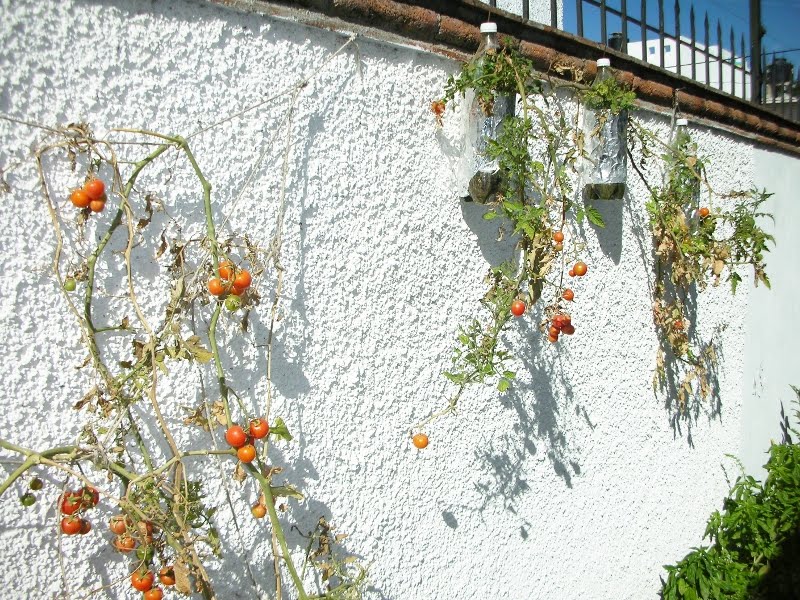
About six plants are all we need to supply ourselves and all of the relatives with cherry tomatoes and at the height of the season we will have tomatoes coming out of our ears. I grow some plants in large "macetas" (mah-SAY-tahs) which are clay flower pots about the size of a five gallon bucket and I grow some in large two or three liter plastic pop bottles that I hang on the garden wall. Other than regular watering and a bit of fertilizer now and then they need very little care. I am always starting new plants that I give away to friends and then listen to them rave about how many cherry tomatoes they are getting. There are two groups of people who love these tomatoes the most...little kids and old people. My "suegro" (SWAY-groh) or "father-in-law" and Gina's little "nieto" (NYET-oh) or "grandson" are always in competition to see who can pick the most tomatoes. I think that God must like cherry tomatoes too, and that is why He made them so delicious, prolific and easy to grow. Thank you God for loving us enough to share your cherry tomatoes with us. I love you back.


About six plants are all we need to supply ourselves and all of the relatives with cherry tomatoes and at the height of the season we will have tomatoes coming out of our ears. I grow some plants in large "macetas" (mah-SAY-tahs) which are clay flower pots about the size of a five gallon bucket and I grow some in large two or three liter plastic pop bottles that I hang on the garden wall. Other than regular watering and a bit of fertilizer now and then they need very little care. I am always starting new plants that I give away to friends and then listen to them rave about how many cherry tomatoes they are getting. There are two groups of people who love these tomatoes the most...little kids and old people. My "suegro" (SWAY-groh) or "father-in-law" and Gina's little "nieto" (NYET-oh) or "grandson" are always in competition to see who can pick the most tomatoes. I think that God must like cherry tomatoes too, and that is why He made them so delicious, prolific and easy to grow. Thank you God for loving us enough to share your cherry tomatoes with us. I love you back.


Subscribe to:
Posts (Atom)
About Me

- Bob Mrotek
- I was born and raised in Chicago, Illinois, U.S.A. I have been living in Mexico since January 6th, 1999. I am continually studying to improve my knowledge of the Spanish language and Mexican history and culture. I am also a student of Mandarin Chinese.
